
The pound jumped on news that Boris Johnson will resign as Prime Minister, while financial analysts and economists predicted potential looser fiscal policy and higher interest rates, among other potential changes in the coming months.
In a speech outside 10 Downing Street, Johnson confirmed his exit, saying it was clearly the will of the parliamentary party that there should be a new leader and new prime minister.
A timetable for the leadership contest will be announced next week, and he said he would remain in place until a new leader was elected.
’Getting Boris gone’ has led traders to hope the next PM will take a softer stance with the European Union on Northern Ireland, said Naeem Aslam, market analyst at Avatrade.
However, it is not likely to be that simple.
What Johnson’s exit does do, is lend some support to the possibility that interest rates will rise from their current 1.25% to around 3.00% next year, said Paul Dales, chief UK economist at Capital Economics.
Johnson stepping down “fires the starting pistol” on a leadership election that is likely to see a crowded field of candidates divided by those arguing for a return to the historic Tory heartland as a low tax party and those pushing for fiscal prudence and discipline, said Jason Hollands, managing director of investment platform Bestinvest.
“Political pressure to cut taxes potentially puts the UK on course for a situation where monetary policy from the Bank of England and fiscal policy from the UK government is misaligned, even pulling in different directions,” Hollands said.
BoE governor Andrew Bailey and those at Threadneedle Street have committed to tightening monetary policy to cut down inflation, even though this will slow economic growth and could lead to recession.
“If tax cuts are on the radar, is expansionary and could mean inflation lingers longer. If the government dials up fiscal stimulus before inflation has clearly peaked, this may ultimately prompt the Bank of England to accelerate the pace of rate rises,” Hollands added.
There could be some immediate policy changes this year, while the leadership race will also see other changes mooted.
Newly promoted chancellor Nadhim Zahawi has hinted that he may scrap the big corporation tax hike to 25% that predecessor Rishi Sunak had pencilled in for 2023, which would be particularly positive for more domestically focused companies.
Zahawi, if he stays in the job long enough, could also bring forward the 1p income tax cut that Sunak promised for 2024, in time to try and win some extra votes before the general election, as well as cutting VAT.
Tax and Brexit are likely to be two of the main dividing lines in the leadership race.
Many in the City will be watching this battle in order to try and divine the precise implications of a leadership change.
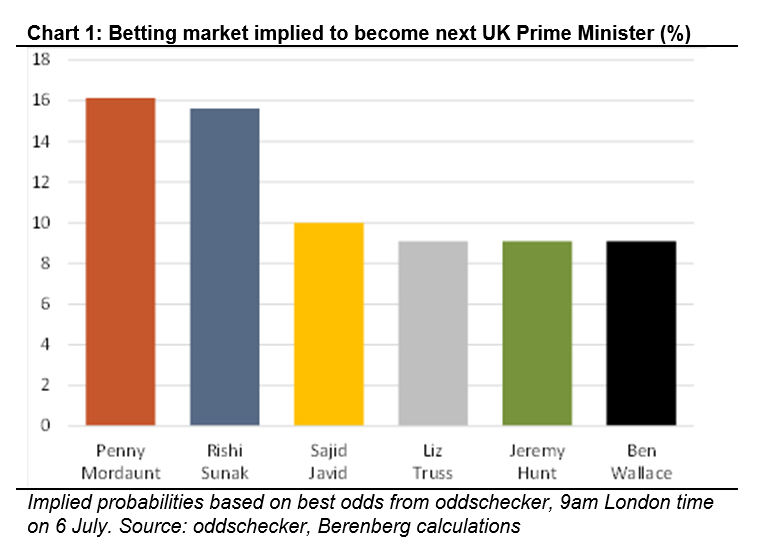
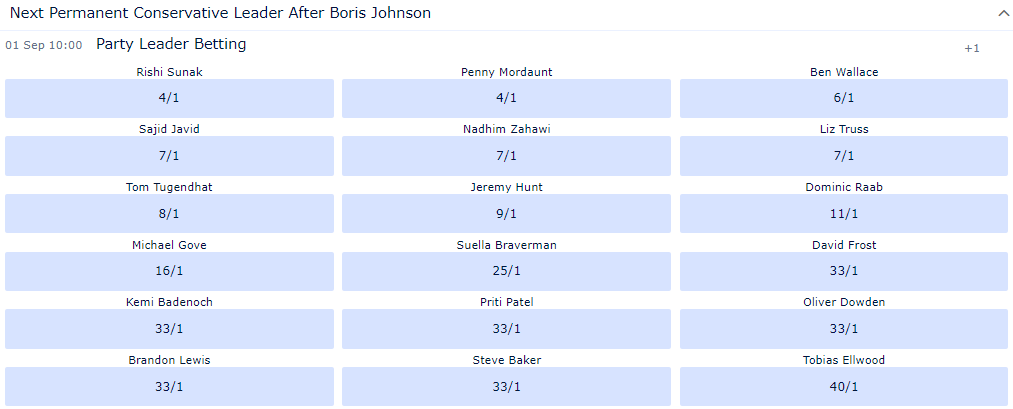
According to current bookmakers' odds, Rishi Sunak and Ben Wallace are favourites, just ahead of Penny Mordaunt, then followed by Sajid Javid and Liz Truss in the chasing pack and Zahawi, Tom Tugndhat and Jeremy Hunt in the peloton.
For James Penny, chief investment officer at TAM Asset Management, a softer stance on Europe and Brexit negotiations will be likely for the winner, as UK businesses found have been “battered” by this of late.
But with Liz Truss and to a lesser extent Penny Mordaunt leaning more to the right and expected to continue to play hardball in negotiations over the Brexit, Dales said this would “mean the pound is weaker than otherwise and inflation is higher for longer”, while candidates like Sunak or Hunt might be expected to take a more constructive attitude regarding relations with the EU which “may mean the pound is stronger than otherwise, thereby easing some of the inflationary pressure”.
“Perhaps the key point is that all candidates will have to lean towards lower taxation to have a chance of being voted in by Conservative Party members,” Dales added.
An ideological desire for lower taxes “may add to inflationary pressure if it leads to a net loosening in fiscal policy”, while fiscal discipline “may not if lower taxes are funded by higher taxes elsewhere and/or spending cuts”.
Given the current poor polling of the Conservatives and the cost of living crisis, a snap general election is thought to be unlikely.