
- FTSE 100 closes 81 points higher
- Sterling also gains on UK political bombshell
- US stocks push higher after Fed minutes relief
4.50pm: Politics aside
The FTSE 100 index ended higher again on Thursday, even as sterling also climbed shoving aside news of the resignation of UK prime minister Boris Johnson following this week’s Cabinet exits, with investors eyeing the battle for the next incumbent of Number 10 and, more importantly, global economic factors.
The UK blue-chip index closed 81.31 points, or 1.1% higher at 7,189.08, below the session peak of 7,213.05 but well above the opening low of 7,107.77.
David Morrison, senior market analyst at Trade Nation commented: “Boris’s resignation is an opportunity for the Tory party to choose a less mercurial leader to take over as Prime Minister. This should steady the boat, bringing an opportunity for the government to concentrate on its problems in dealing with the ‘cost of living crisis’, the ongoing exit from Europe etc. and hopefully fewer gaffs and lies.”
The Footsie ended off highs although Wall Street stocks made positive early progress ahead of the release on Friday of the June US non-farm payrolls report, with Wednesday’s minutes from last month’s Federal Reserve policy meeting providing support as the focus is firmly on the battle against inflation.
In New York, around London’s close, the Dow Jones Industrial Average was up 237 points, or 0.8% to 31,275, while the broader S&P 500 index gained 1.1% and the tech-laden Nasdaq Composite added 1.5%.
Morrison added: “We’re also having a long-overdue recovery in equities, led by the US-tech sector. This is seeing some profit-taking in the US dollar, while short-sellers have been covering their equity positions, lifting stocks globally. Whether this turns out to be a resumption of the bull market, or a bear market rally remains to be seen. But I favour this as a reason for the bounce in the FTSE and sterling."
3.45pm: Footsie and sterling hold on to their gains
Leading shares have taken Boris Johnson's resignation in their stride, even with his unwillingness to actually set a departure date.
Heading into the close, the FTSE 100 is up 91.22 points or 1.28% at 7198.99.
Meanwhile the pound continues to climb in the wake of Johnson's announcement.
Sterling is up 0.5759% at US$1.1989 while against the euro it has added 0.6851% to €1.1786.
Back with equities, and commodity companies are among the day's big winners after reports of further Chinese stimulus measures to support the world's second largest economy.
Antofagasta PLC (LSE:ANTO) has flown 8.51% higher, Anglo American PLC (LSE:AAL) has added 7.09%, Glencore PLC (LSE:GLEN) is up 6.72% and Rio Tinto PLC (LSE:RIO) has risen 4.21%.
Michael Hewson, chief market analyst at CMC Markets UK, said: "A strong rebound in copper prices from 18-month lows in the last 24 hours, is helping the basic resource sector, with strong gains for the likes of Antofagasta, Glencore and Anglo American, after reports out of China suggested that the Ministry of Finance was considering allowing local governments to bring forward about $220bn of infrastructure spending from 2023, into the second part of this year."
Oil companies are also moving higher as crude recovers - Brent is up 3.86% at US$104.58 a barrel after having fallen below US$100 this week - and reports emerge that the sector has secured some changes to the recent windfall tax.
BP PLC (LSE:BP.) is 4.99% better while Shell PLC (LSE:SHEL, NYSE:SHEL) is up 3%.
Hewson said: "Offshore Energy UK, the industry body, said it had secured a change to allow firms to reduce the tax by spending on decommissioning on old fields, and investing in electrification of producing fields, helping to lift BP and Shell shares off 3-month lows.
"Shell is also being helped by its decision to revise up the value of its oil and gas assets, on the back of higher refining margins, as it generates higher returns from higher prices."
Among the fallers gaming group Entain PLC (LSE:ENT) is down 6.23% as it lowered its growth guidance.
The whole sector was weaker on talk that the UK gambling white paper could be tougher than expected.
Flutter Entertainment PLC (LSE:FLTR) is off 4.67% and mid-cap group 888 Holdings PLC (LSE:888) has lost 4.9%.
Persimmon PLC (LSE:PSN) is down 5.28% after a disappointing update and despite an upbeat housing report from Halifax.
And British American Tobacco PLC (LSE:BATS) has dropped 3.04% as its shares went ex-dividend.
3.05pm: Clinging on to power?
So has he gone or not?
Some are not convinced by the resignation news, including the former leader of the Liberal Democrats:
Resigning… but not yet … and now appointing new ministers. He’s not given up has he? This resignation stuff is just a ruse to give him a bit more time to find a way of clinging on…. Or have I turned into a conspiracy loon?
— Tim Farron (@timfarron) July 7, 2022
I hate to point this out but if Boris hasn't been to the Queen he hasn't actually resigned.
— Catherine Philp (@scribblercat) July 7, 2022
And there may be a reason he wants to cling on to power, according to Bloomberg:
NEW: Is Johnson holding on so he can keep Chequers over the summer? pic.twitter.com/M8bIzQt3XQ
— Kitty Donaldson (@kitty_donaldson) July 7, 2022
2.45pm: US markets heading north
US stocks have opened higher as traders digested the minutes from the Fed’s latest rate-setting meeting released yesterday afternoon amid the release of fresh jobs data.
Just after the open, the Dow Jones Industrial Average had added 210 points at 31,247 points.
The S&P 500 had gained 30 points at 3,875 points and the Nasdaq Composite was up 105 points at 11,467 points.
In meme stock news, shares of GameStop Corp (NYSE:GME)were up about 10% at the open after the company announced late Wednesday a four-for-one stock split in the form of a dividend.
Bed Bath & Beyond Inc. (NASDAQ:BBBY) had also jumped about 11% following the news the home retail company’s interim chief executive Sue Gove purchased $230,500 worth of stock.
On the higher than expected weekly jobless claims of 235,000, Pantheon Macroeconomics chief economist Ian Shepherdson said the trend in claims had been flat at around 230,000 lately, despite widespread reports of layoffs, especially in the tech sector.
“Small businesses continue to report difficulty in finding all the people they want, so the bar for layoffs presumably is still quite high, especially in the leisure and travel sectors, where demand is very strong,” he said. “That said, we think it likely that claims will rise gradually over the second half of the year, given slower growth in final domestic demand.”
He noted that he expected some noise over the next few weeks because the seasonal adjustments struggle with the annual automakers’ retooling shutdowns. “When the dust settles, in August, we think claims will be a bit higher than the recent trend,” Shepherdson said.
2.20pm: IAG rises on report of end to check-in staff dispute
Amid the rising miners, another company on the up is British Airways owner International Consolidated Airlines Group SA (LSE:IAG).
Its shares have climbed 3.71% after a dispute affecting its check-in staff at Heathrow airport was suspended, after the Unite union said the two sides had reached agreement on a pay deal.
Overall the FTSE 100 is up 86.59 points or 1.22% at 7194.36.
2.13pm: US jobless claims and trade deficit miss forecasts
Away from the madness that is UK politics, there are some worse than expected figures from the US economy.
The weekly jobless claims have come in higher than expected, up from 231,000 to 235,000. Analysts had been expecting a slight dip to 230,000.
(As an aside, the ADP payrolls report which usually precedes the monthly non-farm payroll figures will not after all be out either this week or in early August as the company revamps the report to make it "more robust").
Meanwhile the US trade deficit fell 1.3% to $85.5bn in May, although economists had anticipated a drop to £84.7bn.
#TradeDeficit in May 2022 down 1.3% to $85.5B. #Exports up 1.2% to $255.9B. #Imports up 0.6% to $341.4B (seasonally adjusted). https://t.co/aAXbC4w2Zm #CensusEconData pic.twitter.com/Jfo1niLpY7
— U.S. Census Bureau (@uscensusbureau) July 7, 2022
12.43pm: Pound and Footsie gain further ground after resignation speech
Following Boris Johnson's confirmation that he is resigning, the pound has picked up further.
Against the dollar it is up 0.4958% at US$1.1980 compared to US$1.1977 before the speech.
Against the euro it is up 0.4019% at €1.1753, up from €1.1749.
The FTSE 100, which was up 0.97% before he spoke, is now ahead 1.24% or 88.34 points at 7196.11.
Boris Johnson speaking now for his resignation pic.twitter.com/022PmWldvh
— Dave Keating (@DaveKeating) July 7, 2022
In his relatively short comments, he said that it was clearly the will of the parliamentary party that there should be a new leader and new prime minister.
A timetable for the leadership contest will be announced next week, and he said he would remain in place until a new leader was elected (a rather contentious plan, to be fair.)
(He is effectively Schrodinger's prime minister - gone and yet not gone).
He of course touched on his usual themes, getting Brexit done, the vaccine rollout and yes, the UK's support for Ukraine.
Naeem Aslam, chief market analyst at Avatrade, said: "Boris is out now, and traders are taking some comfort in this news as they are hoping that the next potential leader may not pick a fight with the EU on Northern Ireland’s issue.
"This optimism has supported sterling and the FTSE 100 today; however, traders must look at things from a wider lens.
"A simple change of leadership isn’t enough to put the country back on track, the challenges are mammoth, and options are limited. It is highly likely that a new leader will try several tactics to win votes, such as increasing the minimum wage to battle the soaring cost of living. But the question is how he/she will finance that?
"More loose fiscal policy will only increase the debt for the country, and with soaring interest rates, long-term problems will become only worse. But one thing that has worked previously is kicking the can down the road and worry about everything later; traders are likely to bet on this."
11.46am: Wall Street indicated higher at the open
US stocks are expected to open higher after the Federal Reserve policy meeting minutes, released yesterday, revealed the US central bank's resolve to rein in inflation.
Investors are also looking to Friday’s, always crucial, US non-farm payrolls (NFP) data for June to see how the labour market is holding up.
Futures for the Dow Jones Industrial Average were trading 0.3% higher pre-market, while those for the broader S&P 500 index were up 0.3% and futures for the tech-laden Nasdaq-100 were ahead 0.4%.
However fears that the world’s biggest economy will slip into a recession are very real amid elevated levels of inflation and rising interest rates. Price pressures look like they have yet to peak. Interest rates too look like they will have to rise much higher.
Naeem Aslam, chief market analyst at avatrade.com, said.“The FOMC minutes made it clear to investors and traders that the Fed is fully committed to bringing inflation lower under any conditions … and investors should not think that the Fed will be done by increasing the interest rate two more times..
“The latest US NFP number is due tomorrow, and despite the fact that the Fed has said that they want to increase the interest rate by 50 to 75 basis points, a weak number could easily shift the expectations among investors and traders."
11.25am: Commodity companies in demand
As we await Boris Johnson's statement, leading shares remain buoyant.
The FTSE 100 is currently up 73.87 points or 1.04%, with miners continuing to provide support.
There are reports of further stimulus measures in China, which could boost demand for commodities in the world's second biggest economy.
Anglo American PLC (LSE:AAL) has added 7.0%, Glencore PLC (LSE:GLEN) is up 6.79%, Antofagasta PLC (LSE:ANTO) is 5.58% better and Rio Tinto PLC (LSE:RIO) has risen 4.45%.
With oil up this morning - Brent crude is 0.82% higher at US$101.52 a barrel - BP PLC (LSE:BP.) is 5.15% better and Shell PLC (LSE:SHEL, NYSE:SHEL) has added 3.18%.
In an update, Shell said it had revised up its own oil price assumptions during the quarter.
AJ Bell investment director Russ Mould said: "Resources stocks were in heavy demand with Shell releasing a teaser ahead of its second quarter results, which revealed just how well it has done out of the recent strength in energy prices."

10.33am: Wildcat candidates tipped for new PM
Political analysts reckon the field is wide open for the next prime minister and there could be some wild cards.
Perhaps not this wild though?
Only one man for the caretaker PM job pic.twitter.com/7N8LksZpBz
— Michael Brown (@MrMBrown) July 7, 2022
10.22am: Sterling off its best but still ahead
The pound has lost some of its inital gains after news that Boris Johnson would finally quit Downing Street, although if he gets his way, not until the autumn.
After hitting US$1.1991 it is now up 0.38% at US$1.1967.
Against the euro, sterling is up 0.36% at €1.1748.
Susannah Streeter, senior investment and markets analyst at Hargreaves Lansdown, said: "With the mood music changing so abruptly in Westminster and Boris Johnson finally deciding to leave 10 Downing Street, the pound lifted against the dollar, heading back up to $1.20 before dipping back slightly.
"With the rollcall of resignations now being updated by the minute, and his newly appointed Chancellor of the Exchequer even calling for him to go, his position looked untenable.
"The pound’s wavering path indicates that that traders believe it’s not quite the end to the political stalemate. Mr Johnson is set to stay in position until the Autumn, and the battle is already commencing over who will be the next leader.
"There is a cacophony of problems on the next Prime Minister’s plate, not least the cost-of-living crisis causing voters so much financial pain. Plus the trading relationship with the EU is still fraught with difficulty given the bill to amend the Northern Ireland protocol. Mooted tax cuts by the new chancellor may be popular with the electorate but risk making the Bank of England’s task of trying to bring down demand and inflation by raising rates even trickier."
Meanwhile the FTSE 100 continues to welcome the news, even though the political infighting is by no means over.
The leading index is up 1.05% or 74.67 points at 7182.44, helped by a more positive mood about the global macro situation.
The more domestically focused FTSE 250 is also higher, albeit not as much, adding 0.87% to 18,755.46.
Victoria Scholar, head of investment at interactive investor, said: "The FTSE 100 is pushing higher for the second day in a row, rallying from oversold conditions after a sharp sell-off earlier in the week, mostly driven by risk-on sentiment that is driving equities higher across Europe after the Federal Reserve’s meeting minutes last night signalled that the central bank is serious about inflation.
"The political risk is having little impact on UK equities with inflation and recession fears as well as earnings the key drivers for equities at this time. The FTSE 100 is largely an international index, so is not closely correlated to the UK economy. It has been relatively resilient this year thanks to its favourable sectoral mix of energy stocks and banks which have outperformed this year amid the war in Ukraine and rising interest rates from the Bank of England which have supported the two sectors respectively."
9.43am: Pound jumps on PM news
A good graphic on the pound's move following the resignation news.
Pretty clear sterling bump from Boris Johnson resigning
— Ben Chu (@BenChu_) July 7, 2022
And given he won't apparently go straight away (although that may yet be disputed by other members of government):
Johnson has made it past Neville Chamberlain. Given the amount of time it will take the Tories to elect a new leader, he'll almost certainly make it past May as well. pic.twitter.com/4PvRppXlzO
— Ian Jones (@ian_a_jones) July 7, 2022
9.30am: Prime minister finally bows to the inevitable
It seems Boris Johnson has finally got the message.
He apparently has agreed to resign but wants to stay on as prime minister until a new Tory leader is elected at the autumn party conference.
Downing Street said he would make a statement before lunchtime.
The pound has gained more ground on the reports, and is now up 0.474% to US$1.197.
Naeem Aslam, chief market analyst at Avatrade, said: "Sterling has moved higher on the back of the news that..Boris is going to leave the office. There is no doubt that Boris Johnson has failed the public on many occasions and the fact that he will be leaving is helping the currency and FTSE 100 for now
"However, political uncertainty has increased as a large number of political cards will come into play where the new Prime Minister may try to [adopt a] more loose fiscal policy which could make the Bank of England's job even more difficult."
9.05am: Builders and ex-divs among the fallers
The disappointment with Persimmon PLC (LSE:PSN) has left the whole housebuilding sector languishing despite the strong Halifax house price survey.
Persimmon itself is down 5.47%, Barratt Developments PLC (LSE:BDEV) is off 2.27%, Berkeley Group Holdings PLC (LSE:BKG) has lost 1.88% and Taylor Wimpey PLC (LSE:TW.) is 1.26% lower.
A number of companies going ex-dividend are also among the fallers.
These include Coca Cola HBC AG (LSE:CCH), down 2.59%, British American Tobacco PLC (LSE:BATS), 1.48% lower, Next PLC (LSE:NXT), off 1.43%, and Aveva Group (LSE:AVV), which has lost 1.44%.
None of this has stopped the FTSE 100, which is currently up 84.69 points or 1.19% at 7192.46.
Neil Wilson at Markets.com said: "Markets have not been massively perturbed by the political machinations – there is not a deep political risk here to UK assets. But I would stress that the outcome from the moves to oust Johnson mean tax cuts are more likely, whoever is in Number 10 at the end of the month. Looser fiscal policy [is] the likely result of political pressures – the ‘cost of living crisis’ looms large – which would only makes it harder to tame inflation; all of which is likely weighing on the pound."
8.17am: Miners lead the way as Footsie heads higher
As Boris Johnson continues to cling on to power by his fingernails, equity markets seem singularly unbothered by the chaos in government.
The FTSE 100 is up 56.77 points or 0.8% in early dealings to 7164.54, adding to Wednesday's gains.
Mining shares, which have been volatile recently, are among the risers with Anglo American PLC (LSE:AAL) adding 3.58% and Glencore PLC (LSE:GLEN) up 3.51%.
Legal & General Group PLC (LSE:LGEN) has been lifted 2.7% after it said it had made a good start to 2022. It said: "Solvency is strong, and we expect to deliver double-digit growth in cash and capital generation at the first half."
But it is not all positive.
Despite the booming housing market and a statement saying it expected half year profits to be ahead of expectations, builder Persimmon PLC (LSE:PSN) has seen its shares fall 6.35%.
The firm said it had built slightly fewer houses in the first half than it had anticipated.
Richard Hunter, head of markets at interactive investor, said: "Despite the unquestionable progress, the sector remains deeply out of favour with a gaping disconnect between actual trading performance and share price performance.
"The end of the stamp duty holiday, the wind down of the Help to Buy programme, supply chain blockages and the cladding issue have all weighed heavily. In addition, recent surveys are giving mixed messages on whether house price growth may be slowing and, inevitably, affordability concerns given the escalating cost of living crisis have added to the sector’s woes.
"Persimmon has also noted additional current issues, such as planning system delays, material supply chain issues and labour shortages, all of which are impacting its ability to grow faster. Revenues are down by 8% in the year so far, and legal completions have fallen by 10%. The company is battling those factors within its control – it has an in-house materials business which mitigates some of the supply chain issues, unlike competitors – but given the backdrop, investors may choose to accentuate the negatives within the statement."
Later come more indications of the state of the US economy ahead of tomorrow's widely watched non-farm payroll numbers.
The ADP payrolls report and weekly jobless claims are both due, while May trade data is also on the schedule.
7.44am: UK house prices see highest growth rate for 18 years
Away from the Westminster chaos, UK house prices continue to soar.
They rose by an annualised 13% in June, up from 10.7% the previous month, acccording to the Halifax.
This is the highest growth rate since late 2004, and unlike the recent Nationwide survey, there is no sign of a slowdown in growth. Nationwide reported an annual rise of 10.7% in June, down from 11.7%.
According the the Halifax, house prices increased by 1.8% in June, the twelfth consecutive monthly rise.
The typical property now costs £294,845, it said, a new record.
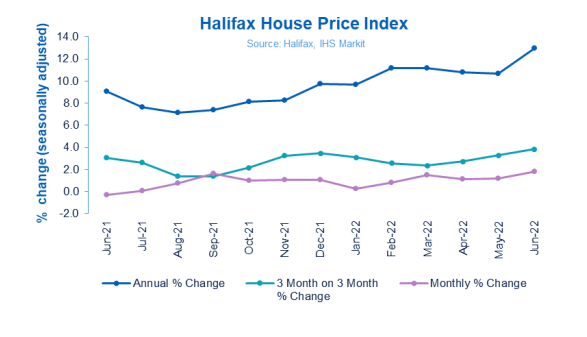
Russell Galley, Managing Director, Halifax, said: “The UK housing market defied any expectations of a slowdown, with average property prices up 1.8% in June, the biggest monthly rise since early 2007.
This means house prices have now risen every month over the last year, and are up by 6.8% or £18,849 in cash terms so far in 2022, pushing the typical UK house price to another record high of £294,845.
“The supply-demand imbalance continues to be the reason house prices are rising so sharply. Demand is still strong – though activity levels have slowed to be in line with pre-COVID-19 averages – while the stock of available properties for sale remains extremely low.
“Property prices so far appear to have been largely insulated from the cost of living squeeze. This is partly because, right now, the rise in the cost of living is being felt most by people on lower incomes, who are typically less active in buying and selling houses. In contrast, higher earners are likely to be able to use extra funds saved during the pandemic, with latest industry data showing that mortgage lending has increased by the highest amount since last September.
“Of course, the housing market will not remain immune from the challenging economic environment. But for now it continues to demonstrate – as it has done over the last couple of years – the unique combination of factors impacting prices. One of these remains the huge shift in demand towards bigger properties, with average prices for detached houses rising by almost twice the rate of flats over the past year (+13.9% vs +7.6%).
“In time though increased pressure on household budgets from inflation and higher interest rates should weigh more heavily on the housing market, given the impact this has on affordability. Our latest research found that the strong rise in property prices over the last two years, coupled with much slower wage growth, has already pushed the house price to income ratio up to a record level.
“So while it may come later than previously anticipated, a slowing of house price growth should still be expected in the months ahead.”
7.11am: Pound higher as government resignations continue
If you take the pound as a clap-o-meter for the prospective exit of the Prime Minister, it is heading higher as more resignations flood in.
Last night saw the 43rd resignation from the government in recent days, with Welsh Secretary Simon Hart also the third member of Boris Johnson’s cabinet to step down.
This morning talking the fourth cabinet minister resigned, Northern Ireland Secretary Brandon Lewis.
And this was swiftly followed by Helen Whately, the exchequer secretary to the Treasury, taking the total to 45.
Sterling is up 0.2% against the dollar at US$1.1943, while the FTSE 100 is tipped for an 86-point gain.
6.52am: FTSE set to continue rally
The FTSE 100 is predicted to extend its gains from yesterday as chaos in Downing Street rolled on overnight and Wall Street made a sliver of gains.
London’s blue-chip index has been called 77 points higher on the IG spread-betting index, following a day where it added just over 82 points to finish at 7,107.77.
Oil heavyweights Shell PLC (LSE:SHEL, NYSE:SHEL) and BP PLC (LSE:BP.) are likely to weigh after another 5% fall in crude prices overnight, with Brent at US$101 this morning – close to a two-month low.
“The primary reason for the current selling pressure on oil prices is that traders are concerned about the possible threat of recession taking place and having a negative influence on the prices,” said market analyst Naeem Aslam at AvaTrade.
“In addition to this, many traders also believe that the worse could be behind us in terms of the oil supply shock as all the sanctions that the US and its allies were going to impose on Russia are already done.”
Gold is also on the back foot, in what Aslam said was a “brutal week” in terms of its price.
“The sell-off for gold prices over the last two days has been intense due to the strength of the dollar.”
In Westminster, last night saw the 43rd resignation from the government in recent days, with Welsh Secretary Simon Hart also the third member of Boris Johnson’s cabinet to step down, with this morning talking this to four in the cabinet and 44 overall, as Northern Ireland Secretary Brandon Lewis resigned.
The pound remains weak, though is up slightly this morning against the dollar at US$1.1957, but close to two-year lows.
Across the pond, US stocks rallied from a negative position to finish slightly higher after the minutes from the latest meeting of the Federal Reserve’s policy committee showed officials in a hawkish mood.
With a third up day in a row, the S&P 500 and Nasdaq both closed almost 0.4% higher, while the Dow Jones edged up 0.23%.
Minutes from the Federal Open Market Committee revealed “almost all participants agreed” to a 0.75 percentage point interest rate hike after they were rattled by the further sharp rise in underlying price pressures in April and May.
“But a lot has changed over the past couple of weeks,” said Paul Ashworth at Capital Economics, with a broad range of commodity prices falling back sharply, as fears mount of a more significant slowdown in global economic growth.
“Whether the Fed hikes by 75bp at its next policy meeting in late-July, or reverts to a 50bp move, will depend on how the incoming data shape up - in particular June payrolls (due this Friday) and June CPI (due next Wednesday).”
Around the markets
- Pound up 0.3% at $1.1956
- Oil up 0.1% to US$100.81
- Gold up 0.4% to US$1744.99
- Bitcoin down 1.8% to US$20,308.45 over 24hrs
6.50am: Early Markets - Asia / Australia
Asian shares were higher on Thursday even as the US Federal Reserve’s meeting minutes released on Wednesday noted that a “more restrictive stance” in policy could be suitable if inflation doesn’t ease, even if it slows the economy.
The Shanghai Composite in China gained 0.39% while Hong Kong’s Hang Seng index was trading 0.02% higher.
Japan's Nikkei 225 advanced 1.37% and South Korea’s Kospi jumped 1.97%.
Australia’s S&P/ASX200 rose 0.8% to 6648 points, buoyed by a rebound across the materials sector.