
- FTSE falls 24 points, or 0.32%
- Investors spooked as Russia-Ukraine threat looms
- Standard Chartered PLC (LSE:STAN) the day’s top performer
4:45 pm: FTSE 100 closes lower on Russia-Ukraine tensions
The FTSE 100 closed lower Friday as Russia-Ukraine tensions persist.
The Ukrainian government and Russian state-controlled media accused each side of violating cease-fire agreements at the border.
At the close, the UK blue-chip index fell 24 points, or 0.32%, to hit 7,513.
Michael Hewson, chief market analyst at CMC Markets UK, said investors can’t get beyond the Russia-Ukraine tensions and the potential for war.
"European markets initially had a more positive tone today, ahead of the weekend as the negativity from yesterday started to be replaced by cautious optimism that there will be no further negative developments ahead of next week’s meeting between US Secretary of State Anthony Blinken, and Russian Foreign Minister Sergey Lavrov,’ he said.
“Unfortunately, the early gains soon disappeared on reports that separatist leaders in Eastern Ukraine were evacuating their citizens in the region into Russia for their own safety.”
Hewson added: “Despite today’s attempts to rebound it’s still been a negative week for the FTSE100, while markets in Europe look set to finish a choppy week pretty close to where they were two weeks ago. The main drags on the FTSE100 have been banks, and the oil and gas sector, as the first weekly decline in Brent crude this year weighs on the sector.”
The top gainer was Standard Chartered PLC, which increased by 3.4% to 576.90p.
-----------------------------------------
The Footsie looks set to end the week on a dull note, as it surrendered the morning’s gains in the afternoon session.
London’s index of heavyweight shares was down 9 points (0.1%) at 7,528, although it was faring a lot better than the mid-cap FTSE 250, which was off 146 points (0.7%) at 21,412.
Cineworld Group PLC (LSE:CINE) led the mid-cap index lower after it reached an agreement to delay payments owed to disgruntled former shareholders of its Regal theatre chain.
The shares shed 2.5% at 38.68p.
2.50pm: Two more UK energy suppliers go out of business
On the day when energy prices on futures markets have plunged, thanks to an increase in energy generated through wind power, two more UK energy suppliers have ceased trading.
Ofgem reported that Whoop Energy and Excel Power, which serve around 536 domestic and non-domestic customers, have closed their doors. Customers of Whoop Energy and Xcel Power Ltd will be contacted by their new supplier, which will be chosen by Ofgem.
“Ofgem’s number one priority is to protect customers. We know this is a worrying time for many people and news of a supplier going out of business can be unsettling,” said Neil Lawrence, the director of Retail at Ofgem.
“I want to reassure affected customers that they do not need to worry, under our safety net we’ll make sure your energy supplies continue. Ofgem will choose a new supplier for you and while we are doing this our advice is to wait until we appoint a new supplier and do not switch in the meantime. You can rely on your energy supply as normal. We will update you when we have chosen a new supplier, who will then get in touch about your tariff.
“Any customer concerned about paying their energy bill should contact their supplier to access the range of support that is available,” Lawrence said.
⚠️ Whoop Energy and Xcel Power Ltd, who serve around 536 domestic/non-domestic customers, have announced they are ceasing to trade.
Customers will be contacted by their new supplier, who Ofgem will choose.
Learn more: https://t.co/G7M7sg0Iv6 pic.twitter.com/mMbizTG7In
— Ofgem (@ofgem) February 18, 2022
Coincidentally, or possibly not, utility companies United Utilities Group PLC (LSE:UU.) and SSE PLC (LSE:SSE) are among the best blue-chip performers; the former is up 1.6% and the later is 1.2% firmer.
The FTSE 100 has, nonetheless, fallen into negative territory, down 7 points (0.1%) at 7,530, probably because US markets have opened softer than expected.
The Dow Jones is off 87 points (0.3%) at 34,227 and the S&P 500 is 6 points (0.1%) lower at 4,374.
2.00pm: SEGRO to the rescue
London’s index of leading shares is just about keeping its chin above water.
The FTSE 100 is up 3 points (0.0%) at 7,540, and the difference could be SEGRO PLC (LSE:SGRO), which is up a mighty 0.8% after its half-year results.
Colm Lauder, a real estate analyst at Irish broker Goodbody said SEGRO is operating well ahead of expectations “and delivered its most impressive year yet in 2021 given the buoyancy of the logistics property market”.
“The strong revaluations continued to be supported by healthy occupier demand and an ambitious development pipeline, all of which added to the rent roll and provides for future growth avenues. Growth is expected to be highest where developable land is in short supply, for example in urban markets such as London and Paris,” Lauder said.
“SEGRO also note that the supply and demand imbalance has created significant accumulated rental reversion in the portfolio. The high inflationary environment is not a concern and they expect to be able to offset these by capturing the significant reversion in lease reviews and renewals as well as benefiting from indexation provisions in its leases. This remains one to own,” Lauder said.
1.00pm: Scottish Mortgage suffers after tech sell-off
Scottish Mortgage Investment Trust PLC (LSE:SMT), down 1.9% at 1,038.5p, is out of step with the Footsie this morning after a rough day yesterday for the tech-heavy Nasdaq index.
The FTSE 100 is nevertheless up 32 points (0.4%) at 7,569 despite the market also getting the barge-pole out for shares in NatWest Group PLC (LSE:NWG), after the bank’s underwhelming results.
According to Gemma Boothroyd at Freetrade, Natwest has got its confidence back and is nearly ready to “split from the hand that’s fed it for years”.
“Emancipation could be on the horizon. That could be good for investors, who should see its share price benefit. Right now though, shareholders are probably licking their chops over back-to-back interest rate rises,” Boothroyd said.
“For a bank like NatWest, an interest rate rise is warmly welcomed news. It means the spread increases between the rate it’s borrowing at and what it’s charging for interest on customers’ loans.
“Although rates have risen, NatWest customers probably aren’t about to see more interest in their current accounts. They’re not going to benefit here, but NatWest is. That’s because the bank’s not worried about luring in more customers eager to make deposits.
“NatWest doesn’t need to entice them with higher deposit rates – it’s already got enough cash on hand.
“It’s all about raising the rates it charges on loans. NatWest’s Q4 net interest margin reached 2.38% - 3 basis points higher [100 basis points = one percentage point] than the previous quarter. That’s NatWest’s profit engine, and so long as it can keep widening that as rates rise, it’ll keep strutting through 2022.
So slowly but surely, NatWest’s getting back up on its feet. Its share price is finally returning to pre-pandemic levels, and investors will be welcoming today’s 7.5p dividend – well over double last August’s payout,” she added.
NatWest shares were off 2.2%.
Find out if your local NatWest or RBS branches closing this year ???? https://t.co/XyEGwWaEwA
— Which? Money (@WhichMoney) February 18, 2022
11.50am: FTSE perks up with US set to open higher
The FTSE 100 is up at its highest levels for the day, climbing almost 33 points or 0.4% to 7,570, helped by a perking up of bank shares and other financials.
A quick return of optimism from across the pond is also providing a boost for market sentiment.
Wall Street futures are pointing upwards, a day after the Dow Jones performed its steepest one-day loss of 2022 of more than 600 points.
Friday's futures indicate the Dow will rise 0.4%, the S&P 500 by 0.5% and with those for the tech-focused Nasdaq-100 up 0.7%.
After what's been a turbulent week for markets, a much stronger performance would be needed to prevent all three from notching weekly losses.
"It promises to be a fascinating end to the week as European equity markets steady and US futures pare losses amid planned talks between the US and Russia next week," said market analyst Craig Erlam at Oanda.
Much like the weather in the UK, he said Friday had been "shaping up to be rather treacherous in the markets", that is until the US and Russian foreign ministers agreed to meet next week.
This seems not good...pic.twitter.com/XPDH8jjq7j
— Jake Kanter (@Jake_Kanter) February 18, 2022
Erlam added: "While we're still being warned that a Russian invasion is highly likely, the meeting does offer hope that nothing will happen before then which is bringing some stability in the markets. In the absence of the meeting, it could have been another turbulent day in the markets and we could still see some risk aversion creeping in as we near the close, given how quickly these situations can change."
Concerns over spiraling inflation and Federal Reserve monetary policy have also kept investors cautious. Minutes from the last FOMC meeting published this week indicated that a US interest rate rise is likely next month.
US home sales data for January is due out this morning and economists expect it will show a slight drop from December.
On the corporate front, pre-market trading has seen Draftkings Inc (NASDAQ:DKNG), a US rival to FTSE 100 members Flutter Entertainment PLC (LSE:FLTR) and Entain PLC (LSE:ENT), tumbling despite beating earnings expectations, with Shake Shack (NYSE:SHAK) and Roku also dropped sharply on updates.
10.50am: Battling headwinds
The Footsie is bravely trying to struggle higher in the face of worries about Ukraine and other wider market headwinds.
Yesterday's reporters Reckitt Benckiser and Standard Chartered are the top risers, building on the gains they enjoyed on the day of their results.
Analysts are giving their considered thoughts on the numbers today, with RB's seen as "reassuring" by UBS and Barclays given the worries about raw material inflation, while Deutsche Bank said management's presentation saw "one of the stronger narratives we have heard in the sector for some time" and with the innovation pipeline full to bursting and "the hard yards of one off transformation largely behind them and with significant room to grow".
StanChart's numbers were seen as pretty mixed but the 'new' 10% RoTE target for 2024 was "well ahead of consensus", says Barclays.
As for today's big reporter, NatWest is among the main FTSE 100 fallers, despite announcing better than expected profits, a hike in the outlook and a combined shareholder return of a 7.5p final dividend and a £750mln share buyback.
Most of this was baked-in to expectations and investors "may be concerned about the possibility of an increase in bad debts as its customers face a cost of living crisis", said analyst Danni Hewson at AJ Bell. "This could outweigh any boost to profitability from higher rates."
But if not, then Natwest should be in a position to dole out more generous shareholder returns, with UBS calculating that the lender will "have to distribute nearly 20% of market cap in 2022 alone between buybacks and dividends" to achieve the 14% capital levels targetted.
9.21am: Downward pressure
London's blue-chip benchmark has had its early gains curtailed as banks, commodities- and tech-related companies weigh.
Oil majors BP and Shell are also dragging on the FTSE 100 as oil prices are sharply lower with WTI back under US$90.
This is "mainly it seems on hopes Iranian crude will return to the market," said market analyst Neil Wilson at Markets.com.
Global stock markets are "on the whole holding up pretty well against these Russia-Ukraine headlines", Wilson said, adding that, "save for some very specific cases the geopolitics matters only on the margins; you’re not making a 1yr+ investment decision based on what Putin might or might not do; that’s all about interest rates and earnings. Nevertheless, equity markets remain sensitive to the headline risk and will be tricky to navigate".
With President Joe Biden saying Russia is set to invade Ukraine "within days" and local reports providing no evidence of de-escalation, diplomacy efforts are continuing with the latest olive branch being that Russia’s foreign minister Sergei Lavrov is set to meet US secretary of state Antony Blinken for talks next week.
Jim Reid at Deutsche Bank said: "This may help avoid a de-risking ahead of the weekend as without it I suspect that few traders would have wanted to go home too long."
With geopolitical risk very much the dominant market theme, Reid highlighted research by equity strategists showing the declines in the S&P 500 around geopolitical events are typically short-lived, with a duration of around 3 weeks to reach a bottom and another 3 weeks to recovery from their prior levels.
"Another pattern is that ultimately, the underlying economic context tends to dominate, so if you believe the template, much might depend on what you thought momentum was before the sell-off," he said.
"One of the effects of developments in Ukraine has been to make investors more cautious about the prospects of aggressive central bank action to tackle inflation," Reid added, noting how market expectations for a Fed and Bank of England rate hike have softened somewhat.
Being in southern England, Reid was most immediately concerned about the arrival of Storm Eunice this morning: "We could be set for the biggest storm since 1990 if the upper end of the wind speed forecasts are correct. This could be a rare weekend where I'm glad I'm not able to play golf given I'm on crutches."
8.34am: Positive start for Friday
The FTSE 100 made a tentative but positive start to proceedings with the spectre of conflict in Ukraine keeping a lid on gains.
Topping the FTSE 100 was warehouse giant Segro (formerly the much more anodyne Slough Estates), which jumped 8.5% after an upbeat update on prospects. Behind its success has been the continued rise of e-commerce.
The 3% tumble in the value of the Nasdaq had its impact on Scottish Mortgage Trust, one of the UK’s biggest investors in Silicon Valley, which saw its shares tumble 2.2% in early deals.
NatWest fell 1.8% early on after it told investors it had been hit by rising prices.
7.41 am: Retail sales bounce back
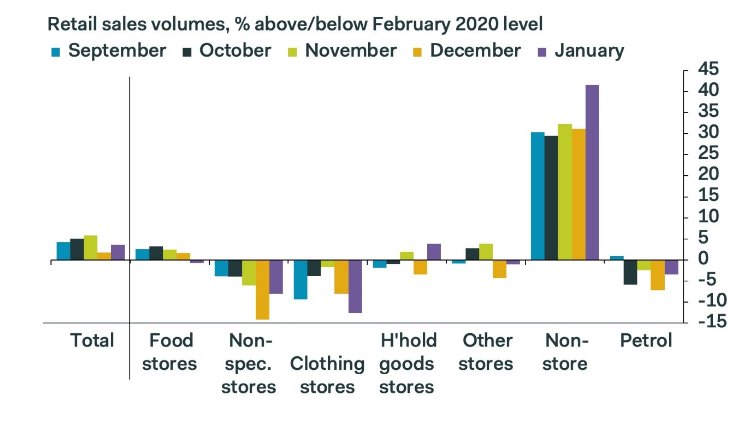
UK retail sales volumes rose 1.9% in January, bouncing back from December’s 4.0% decline.
January’s rise was the largest monthly increase since lockdown rules for non-essential shops were loosened in April 2021 and well ahead of the consensus forecast of 1.2%.
Compared to a year earlier, retail sales volumes were up 9.1%, whereas in December they had been down 1.7% year-on-year; however, the 9.1% increase was below the 9.4% consensus forecast because of revisions to the previous month’s data.
“A rebound in seasonally adjusted retail sales in January always was on the cards after they slumped in December, due to a combination of earlier than usual Christmas gift buying and concerns about Omicron," declared Samuel Tombs, the chief UK economist at Pantheon Macroeconomics.
“January's pick-up was supported by a 3.4% month-to-month increase in non-food sales and a 4.1% jump in petrol sales, as people gradually overcame their Omicron fears. In addition, non-store retailing surged by 8.0%, to exceed its February 2020 level by 41.5%. Food store sales, however, fell by 2.3%, perhaps in a sign that rising food prices are forcing households to purchase fewer goods,” he added.
Despite the recovery in January, sales volumes still were 0.5% below their fourth-quarter 2021 average, and the near-term outlook remains overcast, according to Tombs.
6.30am: FTSE 100 expected to open a tad higher
London’s leading shares are set to claw back a smidgen of yesterday’s heavy losses, despite continued uncertainty over events in Ukraine.
Spread betting quotes point to the FTSE 100 index opening 12 points higher at 7,549.
“Russia has continued to deny that it is increasing the size of its forces, while reports of shelling and firing on a village in Eastern Ukraine by pro-Russian forces, hasn’t helped sentiment, with those same forces blaming Ukraine for the shelling,” reported CMC’s Michael Hewson.
“The uncertainty prompted further declines in Europe as all the Wednesday gains on reports of a Russian withdrawal of some of their troops disappeared in a proverbial puff of smoke.
“It is becoming increasingly clear that the US appears to think a Russian invasion is only a matter of time, and whether it comes this week, or in a few days, US officials want it to be clear that if, and when it does happen, Russia won’t be able to hide behind a ‘false flag’ event to justify it,” he added.
US markets took a bath yesterday with the Dow Jones slumping 622 points to 34,312 and the broader-based S&P 500 tumbling 95 points to 4,320.
This morning, the Nikkei 225 in Tokyo is off 107 points at 27,126 while in Hong Kong the Hang Seng index is 86 points in the hole at 24,707.
In the UK, retail sales figures for January are due out and should be better than the downright awful December numbers.
“There appears to be little doubt that the surge in prices seen in the last two months has shaken consumer confidence and caused a significant pull-back in spending habits. The recent BRC [British Retail Consortium] retail sales numbers saw a decent rebound in January, as sales of homeware and electronics bounced back, while food sales slipped back,” said that man Hewson.
“If the recent BRC numbers are any guide we should expect to see a modest improvement, with a rise of 1.2% expected; however, rising prices and shrinking real incomes is likely to see UK consumers rein in their spending in the coming months,” he added.
On the corporate front, NatWest Group PLC (LSE:NWG) will be the first of the big UK high street banks to release its fourth-quarter earnings.
Analysts are expecting broad growth and the first signs of the impacts of rate hikes on the company’s balance sheet.
UBS forecasts underlying pre-tax profits to rise by 30% year-on-year to hit £817mln, while the impact of UK interest rate raises is not yet expected to be reflected in the company’s net interest margin, down 2% year-on-year.
Around the markets
- Sterling: US$1.3608, down 0.07 cents
- Gilt: 1.894%, down 6.45 basis points
- Gold: US$1,894.60 an ounce, down US$7.40
- Oil: US$92.66 a barrel, down 31 cents
- Bitcoin: US$40,671, down US$37
- Ethereum: US$2,905, up US$9
6.50am: Early Markets - Asia / Australia
Asia Pacific markets were mostly lower on Friday after the Dow Jones Industrial Average suffered its worst day of 2022 on Thursday as investors dumped risk assets amid geopolitical concerns.
Japan’s Nikkei 225 fell 0.41% while South Korea’s Kospi gained 0.03%.
The Shanghai Composite in China rose 0.45% but Hong Kong’s Hang Seng index declined 0.48%.
Australia’s S&P/ASX200 advanced for the third week in a row, helped by robust earnings from blue-chip stocks, despite dropping 1.02% on Friday.