
Has there ever been a time in the last 50 years when investors and Unilever PLC (LSE:ULVR) management alike were not concerned about sluggish growth?
With brands such as (deep breath) Hellmann’s, Vaseline, Ben & Jerry’s, Knorr, Magnum, Wall’s, Cif, Domestos, Dove, Lifebuoy, Lux, Omo and Sunsilk, the company specialises in everyday products – and if you don’t think Ben & Jerry’s is an everyday product then you should meet my wife.
As such, it is difficult for any one brand to achieve explosive growth except by entering new markets. Mostly, growth is achieved by grinding away with incessant marketing to expand the size of the market and/or steal share from competitors.
For the last three years or so, the company’s mantra has been about improving operational excellence and reshaping its portfolio to focus on sectors perceived as being faster growing.
A central plank of its plan to improve operational excellence was simplifying the Anglo-Dutch group’s parent company structure from two legal entities, the Dutch one (NV) and the UK one (PLC), into a single holding company, incorporated in the Netherlands.
So, more of a Dutch-Anglo group than an Anglo-Dutch one.
That idea quickly bit the dust after British shareholders, alarmed at the prospect of Unilever losing its place in the FTSE 100 (thereby sparking a mass sell-off by index-tracking funds) protested forcibly.
Coincidentally or not, the company’s Dutch chief executive officer, Paul Polmann, resigned a month later to be replaced by Alan Jope at the beginning of 2020.
Jope rhymes with hope
One of Jope’s first big tasks was to navigate the company through the pandemic and it made a good start, announcing on 24 March it would contribute €100mln to help the fight against the pandemic through donations of soap, sanitiser, bleach and food.
It also said it would offer €500mln of cash flow relief to help its suppliers and small-scale retail customers.
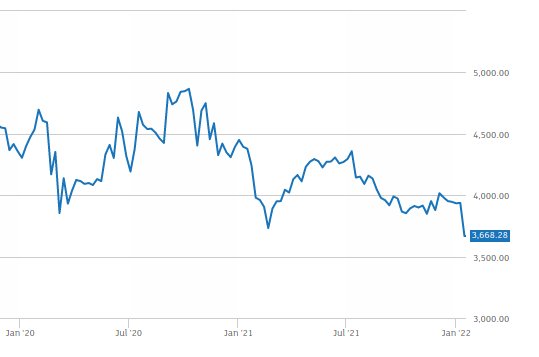
The fact remains, however, that while the FTSE 100 has recovered to pre-pandemic levels, the Unilever share price has slumped to 3,667p from around 4,300p at the beginning of 2020 and investors are beginning to lose patience.
As well as pitching in to combat the pandemic, the group has been keen to stress its commitment to “sustainable growth”.
“We want to do more good for our planet and our society – not just less harm. We want to act on the social and environmental issues facing the world and we want to enhance people’s lives with our products,” Unilever says on its website.
“We’ve been pioneers, innovators and future-makers for over 120 years – we plan to continue doing that and we plan to do it sustainably,” it added.
All very good but star fund manager Terry Smith, for one, would prefer management to concentrate on turning around the business rather than burnishing its green credentials.
"Unilever seems to be labouring under the weight of a management that is obsessed with publicly displaying sustainability credentials at the expense of focusing on the fundamentals of the business," he said in his annual letter to shareholders.
He highlighted the company’s decision to stop selling Ben & Jerry’s ice cream in the West Bank and Gaza last year as an example of misdirected focus, although it is worth noting that Ben & Jerry’s, with its pseudo-hippy ethos, is allowed to operate as a semi-autonomous unit.
Nonetheless, Smith said there were also other "far more ludicrous examples" to illustrate the issue.
"A company which feels it has to define the purpose of Hellmann’s mayonnaise has in our view clearly lost the plot. The Hellmann’s brand has existed since 1913 so we would guess that by now consumers have figured out its purpose (spoiler alert – salads and sandwiches)," Smith quipped.
"Hope you enjoy our new direction" - This is Spinal Tap
All of which sets the background for today’s announcement of a big strategic shift in the works. It is clear from Unilever’s stock market announcement that the weekend press reports of its three approaches – all rebuffed – to buy the consumer healthcare business of GlaxoSmithKline (GSK) and Pfizer (GSK owns 68% of GSK Consumer Healthcare and Pfizer the rest) prompted the group to go public with its plans for a new strategic direction earlier than expected.
We'll get the full-blown details later this month but the Footsie giant has already dropped a few hints of its new direction.
The decision to reshape its portfolio will not come as a surprise. The sale of its tea business, including brands such as Lipton and PG Tips in November 2021 was, according to broker Jefferies, “an important first step” in the group’s portfolio rationalisation journey.
The intention to focus on the Health, Beauty, and Hygiene sectors may be more of an eyebrow-raiser. Unilever believes these categories offer higher rates of sustainable market growth.
Given that even GlaxoSmithKline, keen to talk up the value of the business it is offloading, is only talking about accelerating growth in its Consumer Healthcare businessto 4-6% (on a constant exchange rates basis) over the medium term, we’re not exactly talking explosive growth here.
Furthermore, over the period 2019-2021 the Consumer Healthcare business delivered a compounded annualised growth rate of 4% on a like-for-like basis, so GSK’s projections require whoever ends up managing the business to succeed in accelerating growth.
Can anyone see Unilever succeeding in doing that?
Unilever is not renowned for accelerating growth so although Unilever’s £50bn bid by most accounts does not factor in the so-called bid premium required to persuade GSK to abandon its plans to float the Consumer Healthcare division off as an independent company, it may be a realistic valuation applied by Unilever based on the Anglo-Dutch group’s track record of galvanising acquired companies.