
- FTSE 100 closes 109 points higher
- US stocks recover ground as well
- Omicron impact continues to be weighed
4.50pm: Another bounce back for Footsie
The FTSE 100 index made another 180 degree about-turn on Wednesday, recovering from Tuesday’s losses as worries over the impact of omicron, the deadly new coronavirus (COVID-19) variant ebbed and flowed at the start of the final month of 2021.
At the close on December 1, the UK blue-chip index was 109.23 points, or 1.6% higher at 7,168.68, not far below the day's peak of 7,182.01 and well above the session low of 7,059.35.
On Wall Street, around London’s close, the Dow Jones Industrials Average was 393 points, or 1.1% higher at 34,877, while the broader S&P 500 index jumped 1.6% and the tech-laden Nasdaq Composite added 1.74.
Chris Beauchamp, chief market analyst at IG, a global leader in online trading commented: “US markets joined in the general rally in stock markets this afternoon, after comments from the BioNTech CEO overnight and further data suggesting the Omicron variant is less severe than others helped investors to build a more bullish outlook.”
He added: “A strong ADP report and a fairly solid ISM manufacturing PMI also provided reason for optimism, and this has stabilised the oil price after the dramatic falls earlier in the week.
“Attention now turns to OPEC, but the cartel is likely to keep production either unchanged, or perhaps even throttle back on planned increases, given that the global economic outlook has clouded of late, and the 20% drop in the price that has helped to ease short term concerns about oil costs acting as a drag on economic growth.”
Beauchamp noted: “November went out on a decidedly poor note, a relatively rare event, especially following such a strong October, but it looks like the buyers that failed to show up yesterday have come back in strong form today.
“Fed chairman Powell remained broadly confident on the outlook for the global economy, and from the looks of it the volatility of the past few days is subsiding into a ‘buy the dip’ approach from most investors.”
3.50pm: Mid-caps in demand
The FTSE 250 is outstripping the FTSE 100 today, helped by a strengthening of sterling against the US dollar.
The FTSE 100 was up 86 points (1.2%) at 7,145 while the FTSE 250 was 357 points (1.6%) heavier at 22,876.
Mid-cap 888 Holdings PLC (LSE:888), up 1.5% at 414.8p, slightly underperforms the FTSE 250 despite announcing it has secured a sport betting licence in Virginia, USA.
Spread betting firm IG Group Holdings Plc (LSE:IGG) is 1.% firmer at 780p after revealing it is proposing to sell the North American Derivatives Exchange and its stake in Small Exchange to Foris DAX Markets for around US$216mln.
The best performer among second-liners is Liontrust Asset Management (LSE:LIO) PLC, which is up 14% at 2,335p.
Hot on its heels is Redde Northgate PLC (LSE:REDD), up 13% at 445p, after its interims. The vehicle fleet management specialist saw profit before tax soar to £71.7mln in the six months to the end of October from £25.9mln the year before.
Energy producer Drax Group (LSE:DRX) PLC advanced 9.4% to 601.5p after a trading update in which it said adjusted underlying earnings (EBITDA) for the current year will be around the top end of current analyst expectations.
.
Drax shares soar amid biomass boom, £3bn investment plan by Selby firm - Northern Financial Reviewhttps://t.co/cWjQgPGqJy@Schroders @Vanguard_Group @BlackRock@DraxGroup @SelbyCC1 #Selby #NorthYorkshire @northyorkscc @nationalgriduk #biomass #climate #stocks #shares @AJBell pic.twitter.com/KtYzg7s9zj
— Mark McSherry (@MarkMcSherryNY) December 1, 2021
US markets open higher
As expected, US markets rallied heartily when trading started this afternoon.
The Dow Jones jumped 234 points (0.7%) to 34,719 and the S&P 500 advanced 46 points (1.0%) to 4,612.
ADP, the payrolls processing firm, revealed that private payrolls rose by 534,000 in November in the US, which was “trivially above the consensus”, according to Ian Shepherdson at Pantheon Macroeconomics.
“ADP is not a consistently reliable guide to [US non-farm] payrolls [due out on Friday], but when combined with the Homebase data they have done a reasonable job in most months this year. For November, our model points to a mere 300K increase in private payrolls, but it has undershot in recent months so we look for a 500K increase, down from our previous estimate, 800K,” Shepherdson said.
“We’d love to be wrong about this, but the long-awaited surge to 1M-plus appears to have been delayed, again, suggesting that labour participation remains stuck in a rut,” Shepherdson.
Talking of being stuck in a rut, in London, the FTSE 100 is not only stubbornly refusing to go for the triple-digit gain it is now ebbing slightly, to 7,142, up 82 points (1.2%).
“There are at least a couple of reasons why the bulls might be regaining the upper hand again. Sentiment has improved towards all risk assets today, with the markets shrugging off Omicron concerns and [Jerome] Powell’s hawkish remarks,” said Fawad Razaqzada at thinkmarkets.com.
“The rebound for European markets may be impressive but have a look at the South Africa 40 index, which has hit a new all-time high – if the new covid variant was a major concern, SA stocks would not be at all-time highs this soon after the discovery of Omicron,” Razaqzada suggested.
1.40pm: OECD provides a boost with forecasts of UK economic growth
Aerospace-related stocks are ensuring that the FTSE 100 retains its elevated position this morning.
London’s index of leading shares was up 93 points (1.3%) at 7,152, with British Airways owner International Consolidated Airlines Group (LSE:IAG) SA, up 6.2%, leading the way as Omicron Covid-19 fears recede.
Fellow traveller Rolls-Royce Holdings PLC (LSE:RR.) is also going well with a 3.5% gain at 126.78p.
There has been some good news for the UK economy with the OECD predicting Britain is headed for the fastest growth in the Group of Seven major economies this year and next.
The bad news is that the OECD reckons the economy will suffer a setback if supply shortages are allowed to worsen. Some phrase containing the word Sherlock probably applies here.
The Organisation for Economic Co-operation and Development said labour shortages are emerging in sectors particularly affected by the pandemic “and in which EU-born migrants were also over-represented, such as accommodation and food services”.
Latest OECD forecasts again have the UK economy at (or near) the top of the growth league in both 2021 and 2022, #despiteBrexit etc ????
(Partly just the flipside of the relatively poor UK performance in 2020, but still a lot better than most had expected at the start of the year) pic.twitter.com/GR6VeIOHyw
— Julian Jessop (@julianHjessop) December 1, 2021
12.25pm: Lights go off at Zog Energy
Zog Energy has become the latest energy supplier to throw in the towel, UK regulator Ofgem revealed.
The supplier ceased trading today, obliging Ofgem to appoint a new supplier for the failed company’s 11,700 domestic energy customers.
The FTSE 100 was up 92 points (1.3%) at 7,151, despite a lack of enthusiasm for utility companies such as Severn Trent PLC (LSE:SVT), United Utilities and National Grid PLC (LSE:NG.), which are down 1.2% - 2.4%.
11.50am: US stocks to open higher
US stocks are expected to open higher on Wednesday, recovering from a sell-off in the previous session after US Federal Reserve chairman Jerome Powell said the US central bank will discuss speeding up its bond-buying taper at its December meeting.
Futures for the Dow Jones Industrial Average rose 0.8% in Wednesday pre-market trading, while the broader S&P 500 index gained 1.11% and those for the tech-heavy Nasdaq 100 added 1.3%.
Stocks closed lower on Tuesday after Powell's testimony before the US Senate added to concerns about the new coronavirus (COVID-19) variant, Omicron. At the close, the Dow Jones had dropped by 651 points, or 1.85%, to 34,484 and the S&P 500 fell 1.9% to 4,567. The Nasdaq Composite declined 1.55% to 15,537.
“Most equities dived yesterday, as many didn’t expect to hear a hawkish Powell at a time the new Omicron wave threatens the economic recovery,” Ipek Ozkardeskaya, senior analyst at Swissquote said.
“The kneejerk reaction from the market was strong. The S&P500 and the Dow closed the session near 2% down, as Nasdaq dropped 1.50%. The US 2-year yield rebounded dramatically, and the US yield curve flattened to the levels last seen in March 2020, since the onset of the pandemic.
"But the US equity futures rebounded as fast as they dived in the overnight trading session. Nasdaq futures are up by 1.30% at the time of writing," she added.
In London, the FTSE 100 is taking a serious look at a triple-digit gain and is up 90 points at 7,150.
11.05am: Footsie rallies after Tuesday's setback
The force remains strong in the UK tomorrow but who knows what tomorrow will bring?
The FTSE 100 was up 92 points (1.3%) at 7,152.
“Market volatility has taken a turn over the past week, with indices throughout Europe and the US fluctuating wildly since Friday’s emergence of the Omicron variant. That volatility was particularly evident on Friday when the VIX reached a 10-month high; however, traders are having to base investment decisions on a limited amount of data, with each notable comment bringing knee-jerk reactions in financial markets. Contradictory comments from the likes of Moderna, Oxford, and BioNTech highlight the uncertainty over just how useful the current vaccinations will be for this new variant; however, it will ultimately take 1-2 weeks for the scientists to gain a better grasp of just how much of a problem this strain is going to be. Thus traders should prepare for a highly volatile time, with few places to hide if traders wish to shelter themselves from that uncertainty,” said Joshua Mahony at IG Markets.
After all that talk of volatility, it is perhaps pertinent to note that the Footsie has been hovering around the 7.150 mark all morning, without much corporate news flow to drive share price changes.
On the macroeconomic front, we have been better served with releases from the Nationwide Building Society, the British Retail Consortium (BRC) and IHS Markit/CIPS.
“According to the latest Nationwide HPI [house price index], average house prices have taken a slight jump to 0.9% month on month, or £2,367, which is the highest increase since May 2021; however, this does not mean prospective buyers should be pessimistic. It is likely that with Christmas coming demand has outweighed supply, as sellers look to hold putting their house on the market until after the new year,” said Ross Counsell of Good Move.
“So, what does this mean for the housing market? Right now, with the ‘Omicron’ variant hitting the headlines, there is increased uncertainty surrounding the housing market and the wider economy. What’s more, with inflation set to increase to 5% over the coming months, leading to an increase in the cost of living, first-time buyers, in particular, may be more reluctant to commit to such a large purchase with increased uncertainty on financial security,” Counsell suggested.
As for the manufacturing PMI data from IHS Markit/CIPS, Omicron gets a name-check there as well, from Martin Beck, the chief economic advisor to the EY ITEM Club.
“Interpreting the manufacturing PMI this year has been complicated by the effect of supply disruption in pushing up delivery times and so, perversely, the PMI itself. This influence was present in a rise in November’s manufacturing PMI to 58.1 from 57.8 in October, well above the long-run average of 51.9 but there were also signs of robust activity,”Beck said.
“Higher fuel, energy and raw material prices, alongside input demand outstripping supply, contributed to cost pressures rising at the fastest rate in the survey’s 30-year history.
“The new Omicron COVID-19 variant will bear on these factors. New restrictions in the UK and abroad may add to supply chain disruption in the short term and hold back the pace at which bottlenecks are resolved but positively for manufacturers, tighter restrictions could slow the rotation of consumer spending from goods back to services, albeit a development which would intensify supply pressures. Additionally, oil prices have fallen more than 10% since Omicron’s discovery was announced, which will reduce costs for energy-intensive producers. So, while it’s still too early to be conclusive on the economic effects of the new variant, the consequences for the manufacturing sector may not be all negative,” Beck concluded.
The BRC reports that shop prices rose by 0.3% in November after decreasing 0.4% in October.
The BRC said, “the impact of labour shortages, rising commodity prices and transportation costs have now very clearly taken their hold on consumer prices.”
Long story short: expect Christmas shopping to put more of a dent in the bank balance this year.
9.45am: Mildly disappointing manufacturing PMI
The seasonally adjusted IHS Markit/CIPS Purchasing Managers’ Index (PMI) rose to a three-month high of 58.1 in November, up from 57.8 in October.
All five of the PMI components had a positive influence, as production, new orders, employment and stocks of purchases rose and supplier lead times lengthened, Markit said.
Output increased for the eighteenth month running in November, with the rate of expansion accelerating slightly from October's eight-month low. Companies reported that improved new work intakes – especially from the domestic market – and efforts to build safety stocks supported increased output, the market research firm added.
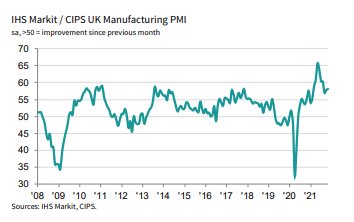
“Although November saw rates of expansion in output and new orders gain some traction, growth remains lacklustre compared to the first half of the year,” declared Rob Dobson, IHS Markit director.
“Manufacturers are facing a challenging backdrop, with rising supply chain disruptions, staff shortages and inflationary pressures stifling growth while ongoing difficulties caused by Brexit and logistical headaches restrict opportunities to expand into overseas markets. New export sales fell for the third straight month,” he noted.
“Firms' costs meanwhile continue to surge relentlessly higher, rising at the steepest pace in the three decades of survey history. Stretched supply chains, component shortages and a vast mismatch between demand and supply are all exerting massive upwards pressure on input costs. This is also filtering through to prices charged at the factory gate, which rose at a rate close to October's record high.
"For those concerned about the strength of the jobs market as support schemes are withdrawn, positive news is provided by a further solid rise in manufacturing headcounts,” Dobson said.
???????? Markit/CIPS Manufacturing PMI Final (NOV)
Actual: 58.1
Expected: 58.2
Previous: 57.8https://t.co/jsJOEzUon4
— DailyFX Team Live (@DailyFXTeam) December 1, 2021
Duncan Brock, the group director at the Chartered Institute of Procurement & Supply (CIPS) said sluggish global supply chains remained uppermost in the minds of manufacturers in November.
“Disruption led to a new three-decade high in terms of mounting prices and supplier delivery times increased for the 29th consecutive month holding back further output.
“New orders flows exacerbated the problem in manufacturing capacity with the fastest intake for threemonths, and it was the domestic market that made up the majority of the new work. Export orders dropped back again as long lead times, port and shipping difficulties caused some clients to lose patience and opt to source elsewhere.
“This didn’t detract from the optimism in the sector as 63% of manufacturers that conditions would continue to improve – if only in fits and starts. With more success in finding skilled labour they are preparing for supply chain issues to even out and for price rises to subside. 74% of supply chain managers paid more for their goods in November, as prices charged also accelerated at a rapid pace raising fears that the UK economy could over inflate if supply chain disruption doesn’t subside in the first quarter of 2022,” Brock concluded.
The FTSE 100 was up 83 points (1.2%) at 7,142.
8.40am: December off to a bright start
Oil and hospitality stocks are driving the Footsie’s strong advance in early deals, as the index’s yo-yo-ing continues into December.
The FTSE 100 index was up 80 points (1.1%) at 7,139.
With the oil price up – Brent crude for February delivery is US$2.73 more expensive at US$71.96 a barrel – BP PLC (LSE:BP.) and Royal Dutch Shell PLC (LSE:RDSB) are getting a lot of love; the former is up 2.8% and the latter is 2.7% firmer.
Hotels owner Whitbread PLC (LSE:WTB) is the top blue-chip riser, however, with a 4.0% rise suggesting that traders are now more sanguine about the prospect of the Omicron variant of Covid-19 sparking more lockdown restrictions.
That view seems to be backed up by British Airways owner International Consolidated Airlines Group (LSE:IAG) SA’s share price; the shares are up 2.2% at 130.24p.
On the macroeconomic front, today’s British Retail Consortium shop price survey signalled increasing price pressures on the High Street in the run-up to Christmas.
“In particular, the headline shop price index was up 0.3%Y/Y in November, suggesting the first year-on-year increase in prices for 2½ years. This reflected a faster pace of retail food price inflation (up 0.6ppt to 1.1%Y/Y) to the highest for a year, as well as a notably softer pace of non-food price deflation – indeed, the survey measure of non-food prices was down just 0.1%Y/Y, the smallest decline since May 2019,” reported Daiwa Capital Markets.
Oh well, Brits can always cash in their pension – i.e. sell their house – to cover rising prices. The Nationwide house price index rose 0.9% in November after rising 0.7% in October, despite the end of the government’s stamp duty giveaway.
Instant Info – Nationwide House Price Index pic.twitter.com/kVFmwdKqYE
— BuiltPlace (@BuiltPlace) December 1, 2021
“This left annual growth at 10% and average prices almost 15% above the level in March 2020 when the pandemic began,” said Martin Beck, the senior economic advisor to the EY ITEM Club.
“It appears that any downward pressure on property prices from stamp duty returning to its pre-pandemic level at the start of October has been countered by other factors. Granted, the after-effects of the tax holiday’s end have made their presence felt in some housing indicators. According to HMRC, 76,930 properties were transacted in October, well down on recent highs and around one-fifth below the pre-pandemic norm. And mortgage approvals fell in October fell to 67,199, the lowest since July 2020. Moreover, stamp duty back at its normal level is not the only headwind facing the housing market: household income growth faces pressures from higher inflation and tax rises, while uncertainty stemming from the new Omicron variant could hold back potential buyers until the situation is clearer,” Beck suggested.
6.45am: Inflation? Schminflation!
The FTSE 100 is set to start Wednesday positively despite Omicron and inflation worries.
CFD firm IG sees London’s blue-chip benchmark up around 60 points, making a price of 7,135 to 7,138 with just over an hour to go until the open.
It comes after Wall Street closed lower as Federal Reserve chair Jay Powel emphasised the Fed’s priority to focus on inflation, with monetary support programmes set to taper regardless of the wall of worry over new Covid strains.
Inflation is not transitory, is what Powell said to the Senate on Tuesday.
“Today’s European open looks set to be a positive one, despite Powell’s sudden shift with the focus, apart from virus concerns, whether they be Delta or Omicron, on the latest manufacturing PMIs, and latest US economic numbers, and a Fed that seems keen to pursue tapering come what may,” said Michael Hewson, analyst at CMC Markets.
Wall Street’s Dow Jones closed 652 points or 1.86% lower at 34,483 whilst the S&P 500 fell 1.9% to 4,567 and the Nasdaq was off 1.55% to 15,537.
The small-cap focussed Russel 2,000 dropped 1.92% to 2,198
In Asia, Japan’s Nikkei was in positive territory up 113 points or 0.4% trading at 27,935.
Hong Kong’s Hang Seng 1as up 1.18% at 23,753 at 23,752 whilst the Shanghai Composite was 0.32% higher at 3,575.
Around the market
The pound: US$1.3329, up 0.23%
Gold: US$1,788 per ounce, up 0.9%
Silver: US$23 per ounce, up 0.84%
Brent crude: US$71.88 per barrel, up 3.5%
WTI crude: US$68.55 per barrel, up 3.8%
Bitcoin: US$57,079, up 1.09%
Ethereum: US$4,750, up 7.8%
6.50am: Early Markets - Asia / Australia
Asia-Pacific shares recovered on Wednesday following losses the day before triggered by uncertainties around the omicron COVID-19 variant.
The Nikkei in Japan gained 0.41% and South Korea’s Kospi surged 2.14%.
China’s Shanghai Composite rose 0.35% while Hong Kong’s Hang Seng index jumped 1.15%.
Australia’s S&P/ASX200 closed 0.28% lower at 7235.9 points as the country’s GDP declined 1.9% in the September quarter, but it was still 3.9% higher than it was at the same point in 2020.