
It’s easy to spot the physical effects of the pandemic. But what about the stuff we can’t see?
When it comes to mental health, experts believe the evolving shadow pandemic represents a serious emergency for our nation.
In this article:
- Australia’s mental health landscape
- The fall and rise of psychedelic science
- It’s in the TGA’s hands
- Emyria and psychedelic research
Before COVID-19, one in five Australian adults were dealing with some kind of mental illness. Now, mental health experts suggest it’s as great as one in three.
With half the country in lockdown and psychology waitlists out the door, treatment options are limited at a time when they’re needed most.
But there might be a new kind of treatment on the horizon.
Psychedelics, which were once heralded as the 'next big thing' in psychiatry, are enjoying a resurgence.
And they could one day be used to combat common mental illnesses like anxiety, depression and post-traumatic stress disorder (PTSD).
Clinical trials in the US have already shown promise, but a decision from Australia’s Therapeutic Goods Administration (TGA) could open the door for further investigation down the line.
If the TGA reschedules psychedelics like MDMA and psilocybin — substances that have proven clinical potential — they could become a viable treatment option in the mental health sphere.
Australia's mental health landscape
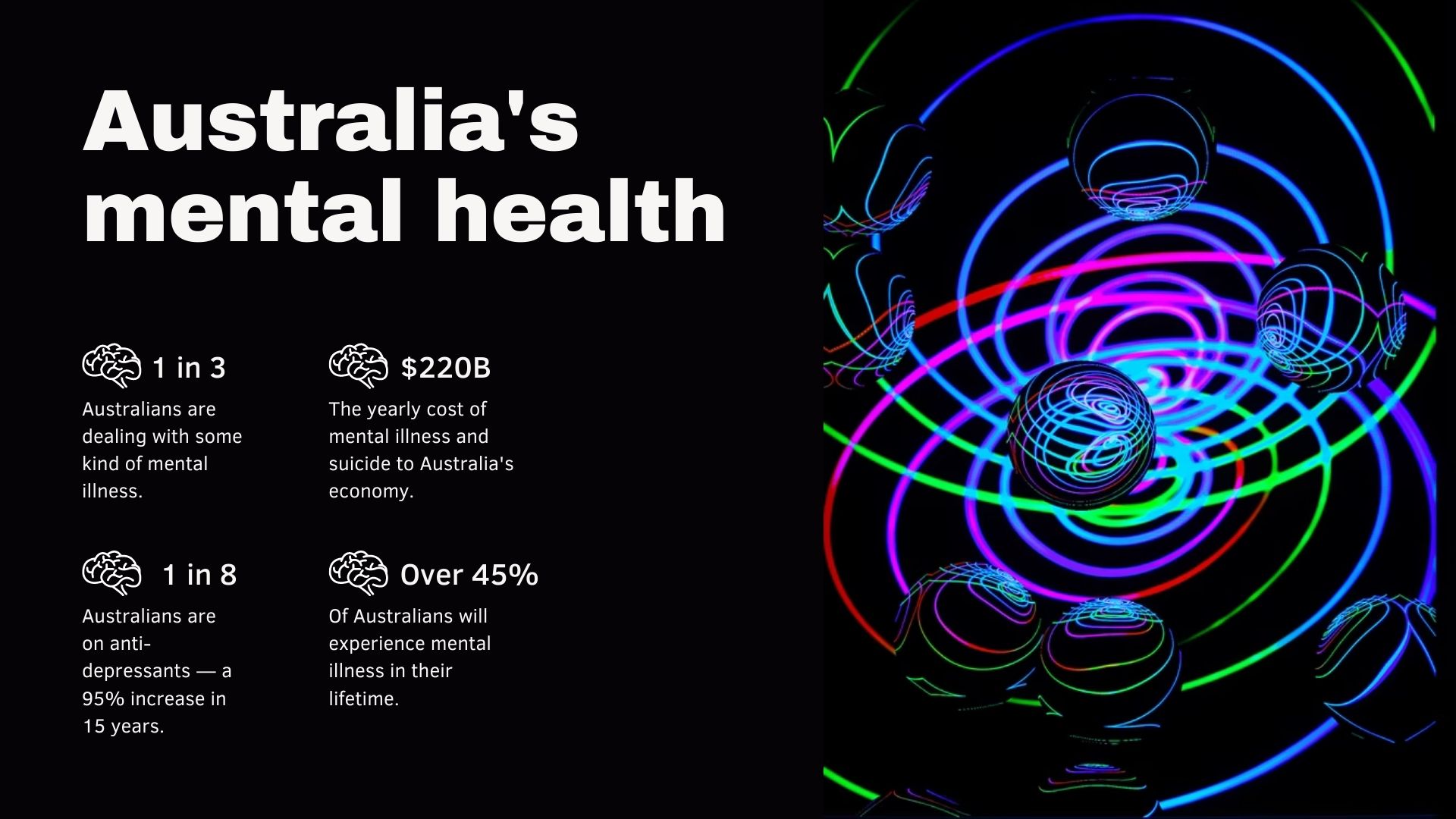
Statistics: Mind Medicine Australia (2021).
Nowadays, more and more Australians are dealing with some form of mental illness.
It can take many forms — anxiety, depression and PTSD are the most common, but there’s also obsessive-compulsive disorder (OCD), anorexia and body dysmorphia.
As these kinds of disorders become more prevalent, there’s been a jump in prescriptions to treat these disorders.
One in eight Australians are currently on anti-depressants — that’s 18% more than five years ago, and almost double the case in 2006.
Among the reporting countries, Australia is the second-highest prescriber of anti-depressants per capita.
But their long-term efficacy is being questioned: only 35% of people diagnosed with depression experience remission from using this kind of treatment.
It’s because of this that Mind Medicine Australia deputy chair and executive director Tania de Jong believes combatting mental illness is more important than ever.
Mind Medicine Australia is a not-for-profit that supports clinical research into psychedelic-backed therapies.
“We have a serious mental health emergency in Australia. And we don't have the tools to treat people and help them get well,” de Jong told Proactive Investors.
“Most of the psychiatrists, psychologists and GPs that we speak to acknowledge that they do not have the tools in their toolbox to treat their patients and get them out of the system.”
Ok, so what’s the alternative?
At the moment, treatment options are limited — and can be difficult to access.
De Jong explained: “Many of the current reforms that are suggested also are not going to get patients well.
“The government suggests things like more patient access gateways, training more therapists, providing more mental health plans, more subsidies and so on.
“But if you can't get to the root cause of a person suffering, and you don't have the treatments that are going to achieve that, then people are either going to remain stuck in the system, which is why the waitlist times are sometimes between one or two years or more.”
De Jong believes now is the time to investigate new treatment options.

For a short time, psychedelics were explored for their therapeutic potential, but a lot of the research ground to a halt half a century ago.
To understand why, we have to go back to one of the most tumultuous and divisive decades in recent history.
One where Woodstock clashed with Nixon’s war on drugs and the first man landed on the moon.
Return of psychedelic science
In the 1960s, clinical research into psychedelics was just beginning.
The early results showed promise, but scientific investigation struggled to establish credibility amid a mounting appetite for recreational drug use.
As drugs were increasingly associated with rebellion, social upheaval and political dissidence, President Nixon declared war.
In 1971, he classified substances like marijuana, LSD, heroin, psilocybin and MDMA in the most dangerous legal category of drugs: Schedule 1.
It effectively kicked off the prohibition and criminalisation of these substances. And that put an end to many clinical avenues too.
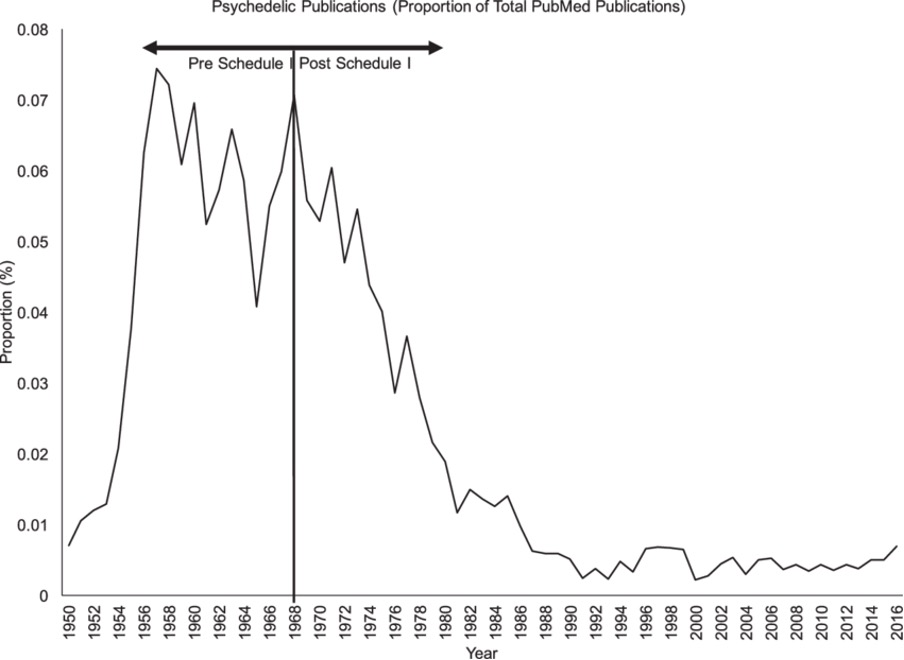
The effect of Schedule 1 on psychedelic drug research. Source: Psychiatry & the psychedelic drugs. Past, present & future.
However, it wasn’t to last — psychedelic research is slowly making a comeback.
And de Jong still believes substances like MDMA and psilocybin could be the next big thing when it comes to future treatments.
“Many psychiatrists from [the 1960s] recall that period is the golden days of their career, because that was when they were really getting patients well and out of the system, leading meaningful, happy and healthy lives.
“Sadly, when those substances were banned, it created this massive hiatus.
“It’s only in the last 10 to 15 years that we've seen this renaissance occurring.”
What does modern research tell us?
Early trials into the efficacy of psychedelics like MDMA and psilocybin indicate they can be as effective — or even more so — than existing treatments for some mental health disorders.
This year, London’s Imperial College saw its psilocybin trial results published in one of the world’s top medical journals — The New England Journal of Medicine.
The team demonstrated that two sessions of psilocybin-assisted psychotherapy were as effective in treating moderate to severe depression over the course of six weeks as daily intake of antidepressants combined with psychotherapy.
Remission rates were also twice as high in the psilocybin group as in the antidepressant group.
De Jong stated: “At the end of the trial … patients in the psilocybin group had far less side effects, less suicidal ideation and so on.”
And in May, a phase three trial into MDMA for PTSD patients suggested MDMA-assisted therapy will be an effective treatment for severe, chronic PTSD.

Institutions with active psychedelic research programs. Source: Mind Medicine Australia.
“67% of [patients] went into remission immediately after three medicinal sessions and a short course of psychotherapy with MDMA-assisted therapy,” de Jong explained.
“They're expecting those remission rates to get up to 80% with further integration with the therapist.”
The Australian Government is also backing further research in this space, putting $15 million aside for psychedelic clinical trials in March 2021.
For these kind of drugs to see wider investigation in Australia, however, there needs to be regulatory progress.
And it all starts with the TGA.
Hold up — what’s this rescheduling program?
Basically, the TGA is a big regulatory body that categorises substances in Australia.
They’ve designed a framework that determines how these substances — everything from medicines to poisons — can be accessed.

So, you can grab painkillers like paracetamol from your local chemist because they’re a Schedule 2 substance, but some antibiotics are Schedule 4 medicines, so you’ll need a doctor’s prescription to buy them.
Right now, substances like MDMA and psilocybin sit at Schedule 9 on the table — that means their clinical investigation is very heavily regulated.
But the TGA is currently considering bringing them down to a Schedule 8 classification — the same category as THC-containing cannabinoid medicines — so that means they could be used in controlled, clinical settings down the line.
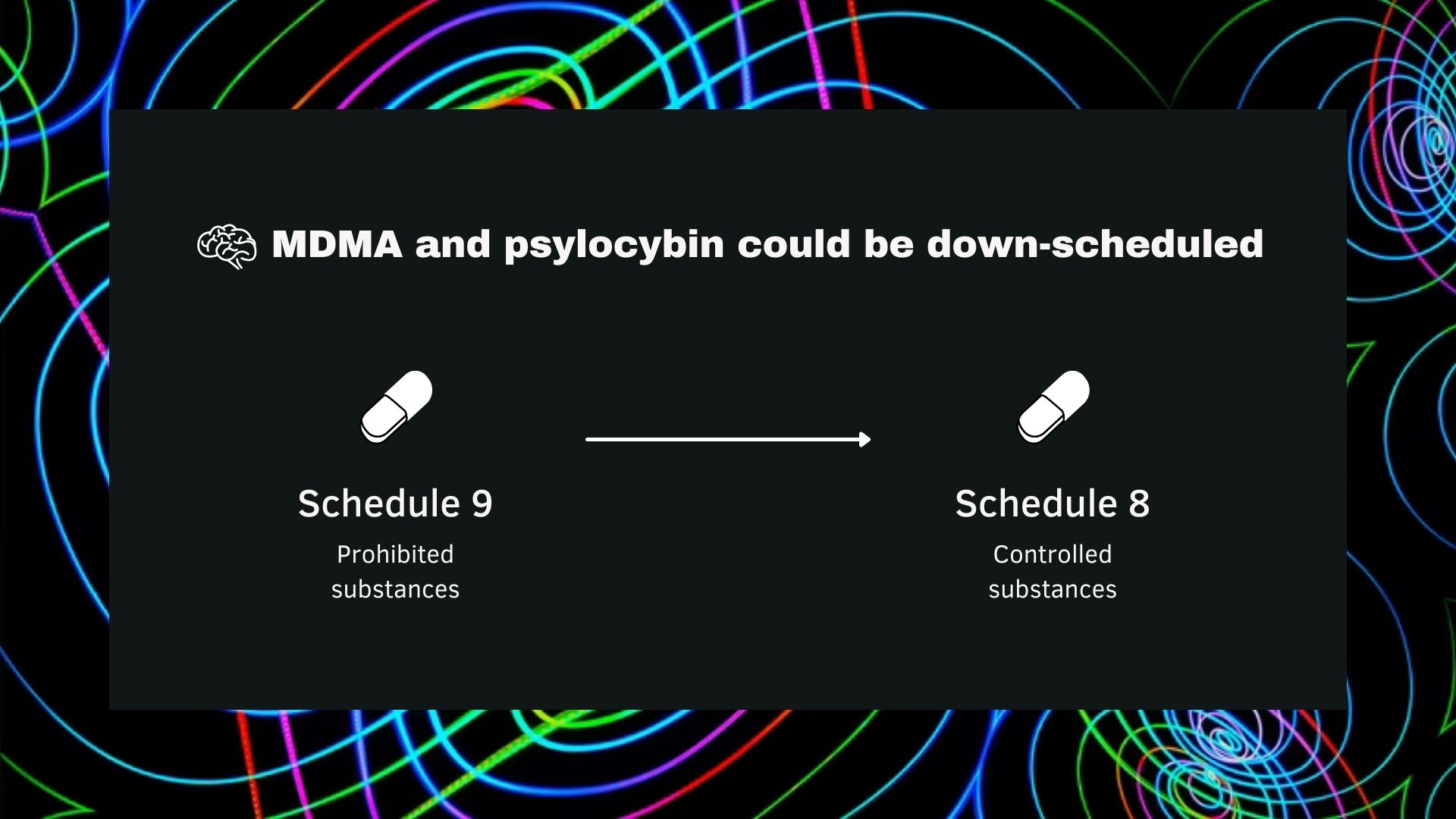
Last year, the regulatory body down-scheduled low-dose cannabidiol (CBD) from a prescription medicine (Schedule 4) to an over-the-counter drug (Schedule 3), meaning some CBD products can be supplied by a chemist without a doctor’s prescription.
Now you’re up to speed!
Ok, so what happened recently?
The September 30, 2021, TGA report is the culmination of months of research into the therapeutic profile of MDMA and psilocybin.
Specifically, it reviews the efficacy of MDMA-assisted psychotherapy for treating PTSD and social anxiety associated with autism, as well as psilocybin-assisted psychotherapy for treating anxiety and depression related to terminal illness, and OCD.
This kind of decision isn’t made in a day: originally, the TGA started talking about rescheduling these substances in mid-2020.
But in February 2021, the regulatory body tabled an interim decision to keep the drugs at a Schedule 9 classification.
At the time, it said there was limited evidence surrounding their therapeutic benefit and maintained there were safety concerns, potential for abuse, and not enough suitably trained psychiatrists to warrant the rescheduling.
Groups like Mind Medicine Australia urged the TGA to reconsider its call, so it formed an independent panel of experts to investigate the therapeutic value, risks and benefits of drugs like MDMA and psilocybin.
That review — which was delayed in April — got handed down on September 30, 2021, and it revealed that these drugs could show promise in certain settings.
Now, these findings will be pondered at an advisory committee meeting, and then a final scheduling decision is expected in the first week of December.
Tell me more about the findings
The September report was a literature review, based on studies elsewhere in the world that are investigating the impact of psychedelics on mental illnesses.
The TGA said: “We conclude that MDMA and psilocybin may show promise in highly selected populations but only where these medicines are administered in closely clinically supervised settings and with intensive professional support.
“In most of the studies psilocybin and MDMA were combined with psychotherapy.
“A major unknown is the degree to which the psychedelic/psychotherapy interaction is dependent on the specific type of psychotherapy administered. This raises the question as to whether clinical practice would need to follow a specific protocol.”
So, that means there’s more information needed about how the effectiveness of these substances is influenced by their environment.
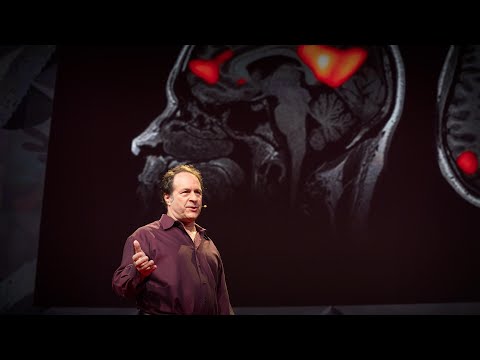
Researcher Rick Doblin speaks to the therapeutic potential of psychedelics in a 2019 TED Talk.
Dr Martin Williams, who’s an executive director at the Psychedelic Research in Science and Medicine, welcomed the TGA report.
“Our firm support for the eventual rescheduling of psychedelics, and their inclusion on the Australian Register of Therapeutic Goods, is based on the emerging evidence from local and international research demonstrating that these drugs may be used as safe and effective adjuncts to psychotherapy in the treatment of refractory mental illness.
“Meanwhile, Australian research needs to be conducted to ensure successful implementation in the local environment, to engage our medical community, and to pave the way towards appropriate training and accreditation of Australian mental health professionals in this game-changing area of mental health practice.”
What would a move to Schedule 8 mean?
This one might surprise you.
In the short term, a down-scheduling won’t do much for access — these drugs are still heavily controlled substances with lots of restrictions, even in clinical settings.
However, it does push the door ajar a little bit further for research in Australia.
That means clinicians have more freedom to investigate the therapeutic potential of psychedelics like MDMA and psilocybin.
Down the track, that could help psychedelics gain a foothold as drugs with therapeutic potential and eventually lead to new treatments for mental health disorders.
Remember how some low-dose CBD medications are now over-the-counter?
That could only happen because cannabidiols moved from a Schedule 9 to a Schedule 8 classification in 2016.
There’s something else important to note — substances generally known as party drugs, like cocaine and ketamine, already sit at Schedule 8.
That’s because in the right clinical settings, they have great therapeutic potential.
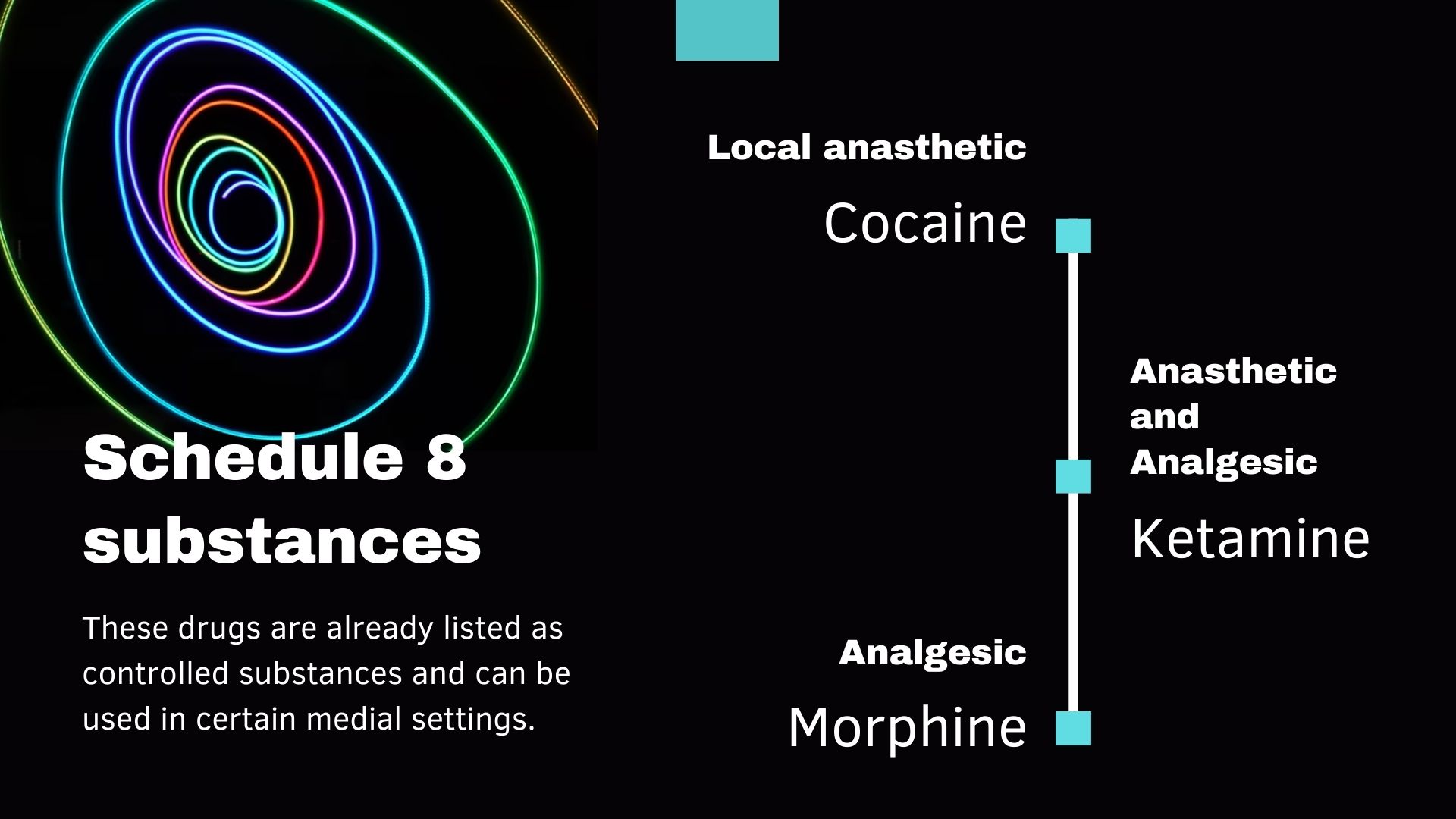
It stands that psychedelics could be the same.
Emyria: an ASX-lister with clinical interest
It’s clear further research into the therapeutic potential of psychedelics needs to take place down under.
And one company heeding the call is Emyria Ltd (ASX:EMD): an ASX-listed biotech with a clinical focus.
Heading up the leadership team is managing director Dr Michael Winlo, who previously worked as CEO of Linear Clinical Research.
While Emyria’s primary care model is often used for cannabinoid-based therapy, it can be applied to a wide range of treatment avenues, which lead to the interest in psychedelics research.
Dr Winlo told us: “These treatments could make a really remarkable difference, and that’s certainly what we're seeing in the research that's been done today.
“That alone should encourage interest and further exploration and how to get the best out of these treatments for the patients in need.”
Even though a down-scheduling would open up more avenues for psychedelic research in Australia, Dr Winlo believes a decision to keep MDMA and psilocybin at Schedule 9 won’t defer Emyria from its mission.
“Schedule 9 still allows us to proceed with clinical research and ethics approved trials and that's our first goal.
“The rescheduling would allow us to run more compassionate access programs and bring in patients that we think could benefit who don't qualify for the formal clinical study.”
As part of its research mission, the Emyria team is working alongside Mind Medicine Australia and other organisations to create a scalable, evidence-based clinical delivery model for MDMA-assisted therapy.
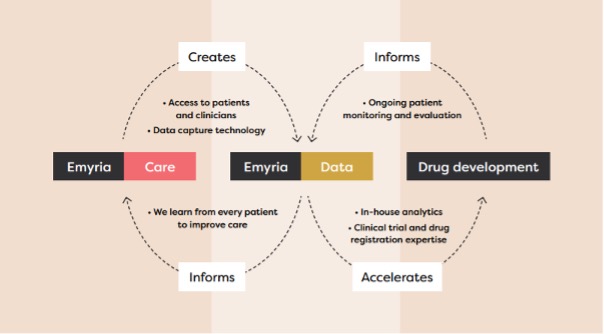
That forms part of its first-ever psychedelics-assisted program, which is now awaiting ethics approval to get started on Australian soil.
But these things take time, and Dr Winlo knows this isn’t just something you can do in a waiting room.
“The nature of the treatment session is quite unique from a medical point of view.
“The environment that the patients will be treated in need to be carefully considered as well,” he said.
“Ideally you're in a space where you limit the patient’s opportunity to interact with others who may be there for different reasons.
“All of that needs to be considered during the treatment.”
What’s around the corner?
As research into the potential of psychedelic-assisted therapies continues to evolve, interest in this space is firming up.
Down the track, curiosity around the medicinal potential of MDMA and psilocybin could inspire a new generation of scientists to develop ground-breaking treatments for the mental health space.
Where this story goes, no one quite knows.
But if the TGA down-schedules in December, it could fling open the door on an entirely new treatment universe.