
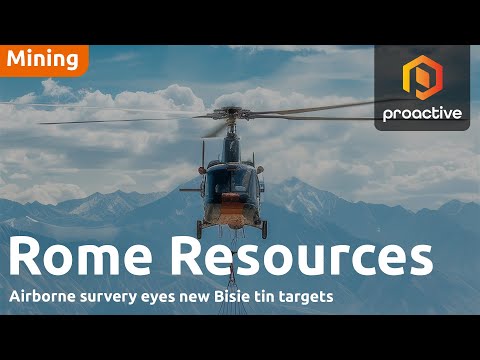
Rome Resources Plc (AIM:RMR, FRA:33R) this week revealed progress on its exploration activities in the highly prospective Bisie tin district in the Democratic Republic of Congo, where the company is participating in a regional airborne geophysical survey designed to improve targeting across its licences.
Speaking to Proactive in the studio, chief executive Paul Barrett said around 25% of the survey area covers Rome Resources’ ground, placing the company “right in the core area” of the programme. The survey combines electromagnetic and magnetic techniques aimed at identifying granite contacts and tracing structural shear zones believed to control mineralisation in the district.
Barrett explained that one of the key objectives is to better understand how mineralised structures extend across the company’s Kalayi licence area. He noted that dense forest cover has made direct geological mapping difficult, while magnetic data could help define the location of the granite contact associated with tin mineralisation.
The company believes the survey may support identification of new exploration targets and assist with future licence planning decisions, including potential relinquishment requirements later this year.
Here, we take a closer look at what was said when Barrett joined the studio team.
Proactive: Paul, very good morning to you. You're participating in an airborne geophysical survey over the greater Bisie tin district in the DRC. Now Bisie is one of the highest grade tin districts in the world. Where does Rome Resources fit into that picture? And what makes Bisie North so significant?
Paul Barrett: It's an interesting survey because it'll be an electromagnetic survey with some magnetics as well. So what we're trying to do, we have about 25% of the total survey area on our block. The rest of it wraps around the granite to the southwest and also to the southeast. So we're right in the core area of the survey.
The idea is really threefold. A lot of the mineralisation increases in intensity as you get towards the granite, and neither Alphamin to the south nor ourselves can really see the granite contact because it’s so heavily forested and it probably runs along river courses. The magnetics should be able to pick that up quite nicely with the tin granite.
So the first thing is to understand where that contact is. Second thing is to follow these shear zones, which are the accommodation space that allows the mineralisation to come in and follow those through. Do they continue to the northwest in our block, or do they wrap around the granite? We just don't know that at the moment.
That will give us some idea of new exploration targets, mainly within the Kalayi licence. We also have to bear in mind that towards the end of the year we'll need to make a decision, depending which route we go with the licences, whether we have to do a 50% relinquishment.
So we need to know which of the relinquished areas to choose based on the fact that they're not prospective. So that's another reason for doing this survey right now, which is really good timing.
Proactive: The survey will calibrate your anomalies against nearby producing mines. What will that comparison tell you about the potential of what you have on your ground?
Paul Barrett: Well, it won't tell you directly what you have in terms of whether you have tin mineralisation or whatever, because tin cassiterite is an oxide and not electrically conductive. It's quite difficult to directly measure from airborne surveys.
What we're indirectly measuring is where the shear zones go. So it's to understand the structural geology more than anything else, and the mineralisation will hopefully follow that.
What we'll probably do if we have some high-grade areas from the geophysics is go in and do some soil geochemistry ahead of drilling. That will be the batting order.
Proactive: Paul, you have Kalayi assays and an updated resource estimate all coming together. Which is the most important near-term catalyst for investors to focus on?
Paul Barrett: Well, the assays you mentioned — we are actually supposed to get some assays today from Kalayi. So yes, this is an ongoing process and this all feeds into updating the mineral resource.
We had these pretty chunky intercepts in the drilling and they need to be confirmed by the assays and then updated in the resource estimate. Those are the key drivers at the moment.
The Kalayi tin resource is the priority at the moment — to really put a number on that for investors going forward and for our next plan in terms of the commercialization of the projects.
We're also looking at how we go forward in terms of quantifying the upside at Mont Agoma in terms of copper and tin, so there’s work to do there as well.
There’s quite a lot to do over the summer. Depending on exactly what we find, both in the assays and in the geophysics survey, we are planning to go back to drilling hopefully towards the latter part of the summer. That again will be quite interesting for investors going forward.
Proactive: Paul, I'm sure we're going to be chatting again very soon. It looks like you have a busy year ahead.