
Drax Group (LSE:DRX) faced a mixed reaction after announcing the government had given consent for carbon capture technology to be fitted to its Yorkshire biomass power plant.
Shares in the FTSE 250-listed power firm dipped 5% as analysts quarrelled over the announcement, with a downgrade by CitiGroup even seeing Drax hit with a ‘sell’ rating.
Though Drax hailed the news of planning consent being approved, it was the elephant in the room of public subsidies to support power production at its plant which analysts focussed on.
Drax already receives hundreds of billions of pounds a year in government funding to ensure it gets a certain price for the energy it produces from the Yorkshire plant.
But in order for its plans to install carbon capture to go ahead - estimated to cost £2 billion - Drax will need more from the government.
Highlighting recent news of the UK’s nuclear power stations staying open for longer and new gas capacity being built domestically, Citi analysts argued such subsidies were far from certain.
“The argument for Drax to receive further subsidies to support reserve margins is becoming less compelling,” the bank wrote, given biomass is relatively expensive.
Indeed, Drax is guaranteed £118.54 per megawatt of energy from its biomass plant, while offshore wind developers will be offered £73 per megawatt for their power from next year.
In spite of Citi analyst’s concerns, Liberum reiterated backing for Drax, noting discussions between the generator and government were still taking place.
“Drax’s investment in the [...] project is contingent upon support from the UK government,” Liberum acknowledged, but such backing is likely given ministers’ plans to create carbon capture hubs in the Humber region and in Scotland respectively.
These would effectively see carbon capture systems combined with heavy industry to reduce emissions, with Drax’s power station located near the Humber ‘zero carbon cluster’ - as dubbed by the government.
From this cluster, alongside the sister site in Scotland, captured emissions would be piped into depleted North Sea oil and gas fields to be stored.
Whether Drax indeed ends up fitting into this will be based on whether it can secure further public funding for its power production from 2027 meanwhile, according to Liberum.
A final investment decision will likely hinge on the result of such talks, the bank added.
How will it work?
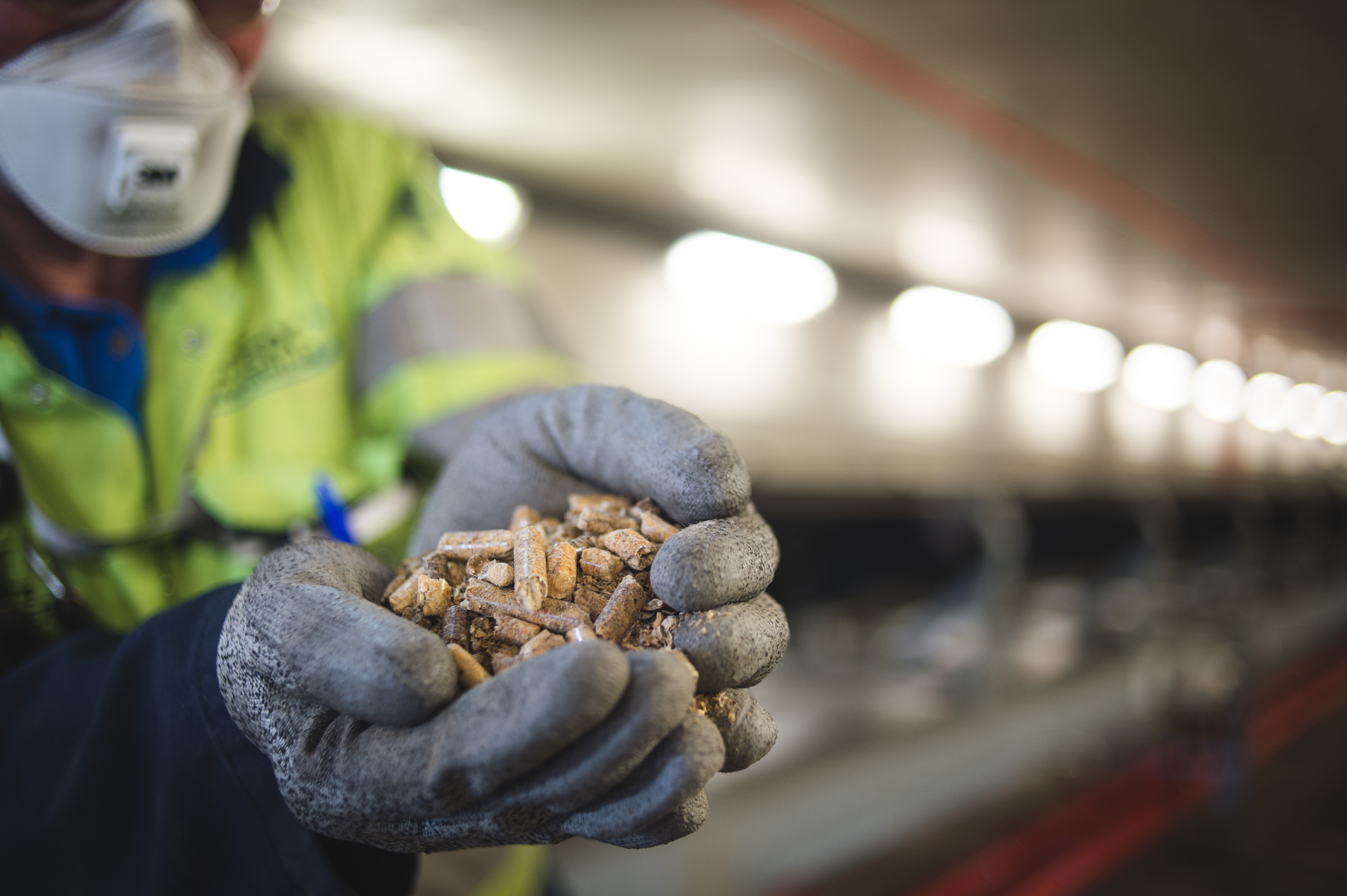
Drax’s power station itself burns wood pellets to produce power, after switching from coal in 2019.
Credit: Drax
Under the approved plans, Drax would retrofit two of the four biomass energy units at the power station to house carbon capture technology .
This in turn would create Drax’s much discussed bioenergy with carbon capture and storage (BECCS) system, where emissions from the burning wood pellets would be separated from gases before being released into the atmosphere, as per Drax.
After the pellets are burned to produce power, flue gas containing emitted carbon dioxide would be cooled and treated before being sent through an absorption tower to remove the greenhouse gas.
Within this absorption tower, the cooled and treated gas would be subject to a chemical reaction using amine solvent, which is a compound of ammonia.
The resultant substance would then be reheated to create a pure stream of carbon dioxide, which would subsequently be transported via repurposed pipelines to be stored beneath the North Sea.