
The recent boom in artificial intelligence and large-language models like ChatGPT is causing a spike in water consumption across the globe, new research suggests.
Large-scale data centres running AI programmes are the main culprits, as they require millions upon millions of gallons of water to operate.
Most tech companies do not track how much water their data centres consume, though Google, Microsoft and other big-tech companies have stepped up transparency on the issue.
In Google’s environmental report released this month, the search giant disclosed that in 2022, it used 5.6 billion gallons of water for its data centres and offices combined.
This is the equivalent of what it takes to irrigate 37 golf courses annually in the Southwestern US.
On the plus side, Google replenished 271 million gallons of water in the year, equivalent to more than 400 Olympic-sized swimming pools.
Microsoft has pledged to become water positive by 2030.
However, the Redmond software giant’s pivot into artificial intelligence has caused a spike in its water consumption.
According to research conducted by the University of California, training large-language model ChatGPT in Microsoft’s US data centres consumed 700,000 litres of clean freshwater.
That’s enough to produce 370 BMW cars or 320 Tesla electric vehicles.
ChatGPT needs to “drink” a 500ml bottle of water to convert and answer a string of 20-50 queries, depending on when and where ChatGPT is deployed, Ren’s research determined.
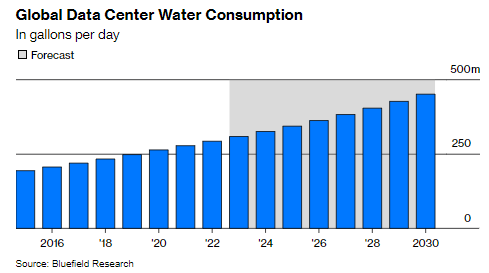
“While a 500ml bottle of water might not seem too much, the total combined water footprint for inference is still extremely large, considering ChatGPT’s billions of users,” said the paper.
“All these numbers are likely to increase by multiple times for the newly-launched GPT-4 that has a significantly larger model size.”
Thames Water mull data centre water limit
In the UK, London and Southeast England supplier Thames Water is considering placing flow restrictions on data centres and charging extra at peak demand times
“Whilst we are looking at physical methods to reduce water use, including introducing flow restrictions on pipes, we prefer to take a collaborative approach with data centres, including encouraging them to explore water reuse and recycling options on-site,” John Hernon, strategic development manager at Thames Water, told Bloomberg.
He stated that implementing a variable tariff might incentivise businesses to consume water during off-peak hours, such as at night.
Over the past year, Hernon's team has been researching data centres’ water consumption in and around London.
However, distinguishing water-intensive clients that are data centres has proved challenging, as these facilities often resemble large warehouses or factories externally, and their operators frequently use separate companies to apply for planning permissions.