
- FTSE 100 closes 56 points lower
- Dow Jones stays weak; Nasdaq gains on Nvidia results
- US credit rating placed on negative watch by Fitch
4.40pm: Another day of losses
The FTSE 100 saw another day of losses that drove the index further into the red, closing 0.7% lower at 7,571 points.
"We’ve seen another day of losses for European markets today as the hangover from yesterday’s sell-off continues to trickle down, as US debt ceiling negotiations move into next week, while a surprise contraction in German Q1 GDP tipped Europe’s biggest economy into recession," Michael Hewson, chief market analyst at CMC Markets commented.
"While the losses in the DAX and CAC 40 have been modest, with tech helping to offer some support, the FTSE100 has remained even more unloved, haemorrhaging further losses to fresh two-month lows...When combined with further declines in natural gas prices in the UK and Europe to their lowest levels since June 2021, this has translated into weakness in BP and Shell which has served to pull the UK index below the 7,600 level for the first time since March 30th."
3.55pm: Crude pressures
Crude oil prices were weaker on Thursday as the US dollar rose to two-month highs after US jobless claims and GDP data both came in better than expected, fuelling hawkish Federal Reserve bets and supporting the view the US economy is going to avoid a harsh recession.
In afternoon trading, UK Brent crude was down 2.6% at $74.72 a barrel, while US West Texas Intermediate (WTI) was off 2.7% at $72.37.
Fawad Razaqzada, market analyst at City Index commented: “While the initial positive reaction in WTI to the stronger US data makes sense, let’s see if the resulting rally in the dollar will prevent oil from making a more significant comeback, following its earlier sell-off. We have seen the dollar strength weigh heavily on metals prices, while Chinese concerns have also worked against commodities. Given these mixed influences and despite the efforts of the OPEC+, the crude oil outlook remains as clear as mud.”
Razaqzada added: “After Saudi Arabia’s Prince Salman warned bearish speculators to ‘watch out’, oil prices have not been able to hold onto their gains. Both oil contracts were trading lower at the time of writing. While there is a possibility that Saudi energy minister’s threat might be a forewarning of more supply cuts, traders are telling Saudi: ‘Bring it on, then’. Having cut production already just a month ago, short sellers are happy to call Saudi’s bluff. They are confident the Kingdom would find it almost impossible to convince the other OPEC members to trim their output again.”
“That being said, the big supply cuts should mean a much tighter oil market in the second half of the year,” he concluded.
3.35pm: Box-ticking boards
A City report has concluded that companies are hesitant to deviate from best practice, for fear of backlash from proxy agencies and in some cases, shareholders, who are setting policies on a “one size fits all” basis and holding companies to ransom through negative voting recommendations.
That finding comes in ‘Better boards for growth companies‘, a report by City broker finnCap, written in conjunction with the Quoted Companies Alliance, which is based on a study that surveyed over a hundred non-executive directors (NEDs) of smaller quoted companies.
The survey gathered insights from the NED community regarding NED remuneration and highlights the challenges faced by growth companies in attracting top talent to their boards. The report calls for a re-evaluation of remuneration practices, greater flexibility in corporate governance guidelines, and a shift in cultural attitudes towards entrepreneurialism and risk.
It concluded that the market has moved towards gold-plated governance where decisions about board selection and remuneration are driven by top-down policy as opposed to strategic outcomes.
The report said: “These policies undermine the flexibility that corporate governance guidelines provide and the flexibility that growth companies need. The individual circumstances and needs of companies should be acknowledged. Equally, companies must ensure transparency of dialogue around decision-making rationale and build trust.”
The survey also highlighted concerns that board selection has become a “box-ticking” exercise and indicated that diversity has become a divisive topic.
3.15pm: Fizz to be lost
Some of the UK's favourite soft drinks could be in short supply this summer because of a series of strikes at Coca Cola Europacific Partners (CCEP).
Hundreds of workers at the largest soft drinks plant in Europe, in Wakefield, have voted for industrial action by a margin of 87% in protest over a pay offer which does nothing to address the cost of living crisis.
The workers are planning 14 days of strikes between Thursday 8 June and Thursday 22 June.
In a statement, Unite general secretary, Sharon Graham said: “Coca Cola Europacific Partners is making profits in the billions but it's delivering a pay cut to the very workers who are making them.
“Its profits are up 37% to an astronomical £1.85 billion. Offering workers a real terms pay cut when business is booming is nothing short of corporate greed. The workforce are rightly furious at the company’s profiteering.
“The workers at Wakefield have Unite’s total support.”
CCEP’s products include Coca Cola, Diet Coke, Coke Zero, Dr Pepper, Fanta, Fanta Lemon, Fanta Fruit Twist, Sprite, Monster and Relentless. The plant, which can produce 360,000 cans per hour, and 132,000 bottles per hour, also produces Schweppes Tonic, Diet Tonic, Bitter Lemon, Ginger Ale and Lemonade.
2.50pm: Oh to be in tech
The FTSE 100 index was languishing at session lows as Wall Street started mixed on Thursday, with US blue-chips falling on debt default concerns, but the tech-laden Nasdaq jumping after strong results from Nvidia.
Around 20 minutes after the New York open, the Nasdaq had added 1.3%, while the S&P 500 was up 0.6%, but the Dow Jones had fallen 48 points or 0.2% at 32,751.
NVIDIA shares were up 24.9% at US$381.50, sending fellow AI stocks Advanced Micro Devices, C3.ai, and Taiwan Semiconductor Manufacturing up 9.4%, 5.7%, and 9.7%, respectively.
Meanwhile, US first-quarter gross domestic product (GDP) was upwardly revised to 1.3% quarter-over-quarter annualized from 1%.
“NVIDIA news and US GDP data have offset news that the Fitch Ratings agency has put the US AAA rating on negative watch, citing concerns over the debt ceiling negotiations,” commented FOREX.com market analyst Fiona Cincotta.
2.30pm: US growth not an issue (unlike debt!)
The US economy grew faster in the first quarter than initially estimated, according to figures released by the Commerce Department.
US gross domestic product (GDP) rose at an annualised rate of 1.3%, in the first three months of 2023 up from an initial estimate for 1.1% growth.
In the final quarter of 2022, US GDP growth was 2.6%.
2.15pm: Vodafone ringing in
Vodafone Group PLC will see almost no revenue growth over the next five years, according to analysts at a leading investment bank.
Sales at the mobile phone giant have been stalling recently and UBS analysts predict that by March 2028 they will be at €46.2bn annually or just 1% higher than the €45.7bn reported in its latest results a week ago.
Instead, said the Swiss bank's analysts, any investment case rests on M&A deals, shareholder Etisalat upping its stake and cost cutting, where new chief executive Margherita Della Valle has already announced 11,000 jobs are to go.
UK consolidation - with Three often reported as the partner - and disposals in Spain and Italy are likely, with post any restructuring a free cash flow yield of 9% one of the company's appeals, they noted.
That’s enough for the UBS analysts to stick with a 'buy' rating, plus it also sees the self-help efforts boosting profits by 40% to around €4.6bn in 2028 from €3.1bn in the year just ended.
Their twelve-month target price for Vodafone is 105p against the current share price of 81.96p, down 2% today.
1.30pm: A glance at some of today’s movers
Risers
Actual Experience - up 8% to 0.89p: The analytics firm jumped after announcing a contract with the UK government had been extended. Britain's Department for Environment, Food and Rural Affairs (Defra) in partnership with Vodafone is working with Actual’s Digital Workplace Management Platform (DWMP).
Phoenix Copper - up 12% to 24.6p: Shares soared after it said it is edging closer to production and is looking to fund first production at the Empire Mine copper mine with minimum additional dilution to shareholders.
Mercantile Ports and Logistics - up 22% to 4.8p: Shares gained on news its subsidiary entered into a five-year contract with Lucky Marine Shipping & Logistics PVT Ltd for container handling services at the Karanja facility in Navi Mumbai, India.
Fallers
RA International - down 11% to 14p: The specialist in remote construction sites reported a big fall in underlying profits and remained cautious for the year ahead, which sent shares tumbling.
Headlam - down 8% to 240p: The company revealed that lower residential volumes due to the current economic environment and weak consumer confidence and reduced-price increases have impacted its gross margin.
1.00pm: Mixed fortunes expected for US stocks
Ahead of the restart in the US and the FTSE 100 is down 22.25 points, or 0.3%, at 7,604.85.
US stocks are expected to diverge at the open on Thursday morning, with blue chips seen lower as Fitch Ratings placed the US's triple A rating on negative watch due to debt default fears, while tech stocks got a boost after a strong earnings beat from Nvidia.
In pre-market trading, futures for the Dow Jones Industrial Average (DJIA) were 0.4% lower, but those for the S&P 500 index gained 0.6%, and contracts for the Nasdaq 100 jumped 1.9%.
On Wednesday. the DJIA closed 255 points, or 0.8% lower at 32,799, while the S&P 500 lost 0,6%, and the Nasdaq Composite fell 0.5%, reflecting the lack of news out of US debt ceiling extension talks.
Overnight, Fitch Ratings put the US AAA long-term foreign-currency issuer default rating on a negative watch. The rating agency said the ongoing debt ceiling negotiations have raised the risks that the US government could miss payments on some of its obligations. However, Fitch said it still expects a resolution before the X-date, assumed as June 1.
Ipek Ozkardeskaya, senior analyst at Swissquote Bank commented: "US stocks and bonds fell on Wednesday as the US politicians still didn’t seal a deal to raise the debt ceiling and the Federal Reserve (Fed) minutes showed dissatisfaction with the speed at which inflation slows. The Fed wants to either keep rates steady or further hike the rates to continue their battle against inflation."
Ozkardeskaya added: "And now Fitch threatens to cut the US’ AAA rating as the political theatre has real-life implications for the economy, and for investors. JPM now sees the US default risk at 25% - whatever default means for them. US T-bills maturing on June 6th are now yielding above 6.5% while those maturing by the end of the month are yielding just around 3%.
"Besides the fact that the US could default on its payments, no one knows what default would look like to bondholders. Will the holders of the potentially defaulted bonds lose all, will they lose a couple of days payments, what will be the legal implications. No one wants to take the risk, or the headache until a debt ceiling deal is reached."
But countering the gloom, Nvidia shares surged higher in extended-hours trading after the artificial intelligence beneficiary gave stronger-than-expected revenue guidance for its fiscal second quarter, while also reporting beats on the top and bottom line in the previous quarter.
Although, on the other hand, Snowflake shares tumbled after-hours as the cloud computing company gave weaker-than-expected product revenue guidance for the fiscal second quarter.
12.45pm: Some mortgage products withdrawn on bond yields jump - Reuters
Continuing the Truss theme and Reuters is reporting that the jump in UK borrowing costs this week has forced some smaller British mortgage lenders to temporarily withdraw and reprice products for new customers.
The move, following the rise UK government bond yields, yesterday and today, has some echoes of the turmoil in the mortgage market last autumn after the disastrous mini-budget.
Reuters reported that at least seven small lenders, mostly focused on the buy-to-let market, have pulled products or announced a repricing this week, according to mortgage brokers they contacted.
But none of the major high street banks have withdrawn or repriced products this week as a result of the market conditions, they add.
The FTSE 100 is now down 22 points at 7,605.
12.27pm: Bond yields rise to "Truss levels"
Yields on government bonds have continued to rise as investors brace for further interest rate rises from the Bank of England in the wake of yesterday's inflation figures.
The headline CPI rate fell to 8.7% in April, above City forecasts of 8.2%, while the core inflation rate - which strips out volatile energy and food costs - rose to a 31-year high of 6.8% in April from 6.2% in March.
The 10-year yield on Government gilts has risen a further 11 basis points to 4.32%, the five-year yield by 11bp to 4.23% while two-year yields have also jumped 10 points to 4.44%.
All are at levels last seen during Liz Truss's time as prime minister when bond yields surged in the wake of her uncosted borrowing plans in the ill-fated mini-Budget.
Excluding the mini-Budget period, the increase would be the biggest over a week since June 2008 when the global financial crisis was building.
Meanwhile, the FTSE 100 is now down 19 points at 7,607, above an earlier low of 7,577.68.
11.55am: Nvidia market value jumps $200bn in pre-market - more than Intel is worth
It could be a tale of two markets in the US later today with Nvidia's forecasting-busting numbers expected to drive the Nasdaq sharply higher.
Futures for the tech-laden index are up 1.8% while those for the DJIA are currently lower.
The Santa Clara, California-based chip maker surprised the market with a $11bn sales forecast for the three months ending in July more than 50% ahead of Wall Street’s previous estimates.
With shares up 27.5% in pre-market trading, Nvidia's market value is set to rise an astonishing $203bn approaching more than double the value of the whole of Intel - market value of $121bn at last night's close.
It takes the firm in touching distance of the $1trn mark with the value of the company around $950bn.
A further $50mln rise would mean it joining Apple, Microsoft, Alphabet and Amazon in the elite group of companies valued at more than $1trn.
“Last year’s share price slump after a profit warning, a slowdown in demand for graphics card sales and a surge in inventory all seem like a distant memory after NVIDIA’s better-than-expected first-quarter results and huge upgrade to second-quarter revenue and profit forecasts,” says AJ Bell investment director Russ Mould
11.14am: Retail sales dip May but expected to stabilise next month
UK retail sales declined in May after a modest rise in April but stores expect sales volumes to stabilise in June as consumer confidence improves and energy prices fall, a survey showed.
The Confederation of British Industry's (CBI) monthly distributive trades index fell to -10 in May from +5 in the previous month while a measure of expected sales in the month ahead rose to zero from -7.
Martin Sartorius, principal economist at the CBI, said retailers had some reason to be optimistic about the outlook.
"Consumer sentiment has been improving and households’ energy bills are set to decline from July," Sartorius said.
Retail sales volumes dipped slightly in the year to May, according to the latest CBI #DTS. Retailers expect sales volumes to stabilise next month pic.twitter.com/mSPSMYAzaH
— CBI Economics (@CBI_Economics) May 25, 2023
The survey showed retail employment fell for a third quarter running in the year to May 2023, and at the fastest pace since February 2009.
Headcount is expected to continue falling at a broadly similar pace next month.
Investment intentions also fell further in May, with retailers expecting to cut back on capital expenditure in the coming year to the greatest extent since May 2020.
10.39am: QinetiQ jumps on upbeat revenue forecast
Shares in QinetiQ Group PLC (LSE:QQ.) jumped 1.5% after the UK defence and technology group said it expects to double its revenues to around £3bn in the next four years as heightened geopolitical tensions and the war in Ukraine drive demand for its expertise.
The FTSE 250 company, which specialises in areas such as robotics and directed energy weapons, reported a rise in full-year profit and revenues to the end of March amid record orders. Underlying pre-tax profit climbed 33% to £189.7mln, with revenues up 20% to £1.6bn.
The FTSE 100 is steadily eating away at its earlier losses, now down just 8.60 points at 7,618.50.
10.17am: UK car production rises as exports soar
British car manufacturing made further gains in April, with output increasing for the third month in a row, up 9.9%, according to the latest figures by the Society of Motor Manufacturers and Traders (SMMT).
Mike Hawes, SMMT chief executive, said, “UK car production is starting to motor again, good news for the sector and the many thousands of jobs and livelihoods it sustains.”
The data showed 66,527 cars rolled out of factory gates, 5,973 more than in April last year as global supply chain shortages, most notably of semiconductors, continued to ease.
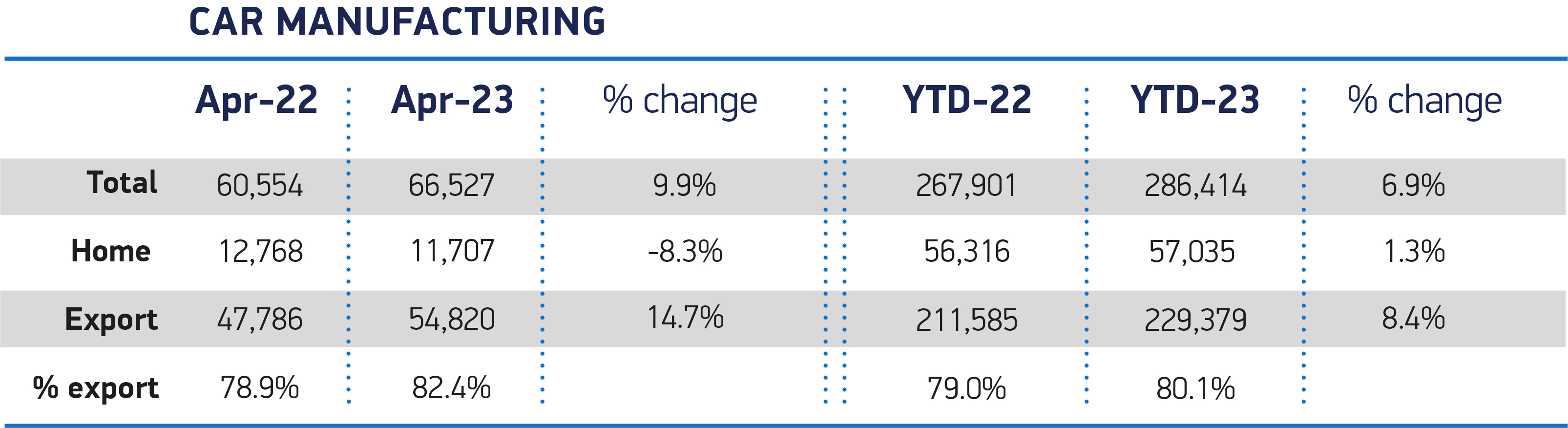
Exports drove volumes, rising 14.7% to 54,820 units, with more than eight in 10 cars (82.4%) heading overseas, this was the third month in a row that exports saw a double-digit rise.
The European Union remained by far the most important global market, taking 58.4% of all exports, equivalent to 32,002 units with volumes up 12.2%, followed by the US, China and Australia.
Shipments to these destinations changed by 36.2%, -3.6% and 226.8% respectively, with buyers choosing the latest British-built models, including many with hybrid or zero-emission powertrain technology.
UK factories continued to turn out increasing numbers of hybrid electric (HEV), plug-in hybrid (PHEV) and battery electric vehicles (BEVs), with combined volumes up 56.2% in April and representing well over a third of all production (37.7%).
The news comes as the UK and EU automotive sectors face a looming cliff-edge with rules of origin agreed in the UK-EU Trade and Cooperation Agreement, governing local content for electric vehicles and batteries, due to get tougher from 1 January 2024.
9.47am: Debt ceiling deadlock a "charade and a mess"
Neil Wilson at Markets.com described the ongoing stalemate in US debt ceiling as a “charade and a mess.”
But is June 1 really the deadline? Not really, Wilson said, “June 8 is seen as more realistic but it could go on a lot longer, perhaps as long as October.”
“In all likelihood, absent a deal, we push on through to end of June and there is a bit of reset, which could see end of August as the next X date,” he suggested.
“The GOP can reason this pretty well and this would tend to mean there is less chance of a deal before June 1st – but that doesn’t mean less chance of a deal at all.
“It just means everyone thinks June is not really a pressing deadline,” he felt.
Even if August comes around and the debt limit is hit, you don’t just default, he said, adding the US can delay and prioritise payments.
But he added if a deal isn’t done by the X date there will be spending cuts, a shutdown perhaps, “which could see spend cut by as much as 10% of GDP. “
“This would lead to a considerable economic hit,” he said.
While the overriding feeling is the assumption that a deal will get done a failure to do so could “see some serious shockwaves” in financial markets.
“Unless a deal gets done before Jun 1st or Jun 8th, then we could be heading for a protracted debt ceiling standoff that lasts months,” he feared.
9.25am: Coca-Cola HBC shares weaken despite upping revenue guidance
Coca-Cola HBC AG shares have dipped around 4% making them of the worst performers in the FTSE 100 despite increasing revenue forecasts and reiterating guidance for the year.
The company updated financial forecasts for the “medium-term” beyond 2023 ahead of its Investor Day.
It now forecasts average annual organic revenue growth of 6-7% (previously a target of 5-6% per annum), average annual organic EBIT margin expansion of 20-40 basis points per annum and capital expenditure as a percentage of revenue in the range of 6.5-7.5% per annum.
It also reaffirmed its commitment to a progressive dividend representing a pay-out ratio of between 40-50% of comparable EPS and said it was on course to meet guidance in 2023.
Analysts at Jefferies said: “The increase in the mid-term guidance range from 5-6% org sales to 6-7% points to a favourable footprint growth (historically 2-3%) as well as benefits from price and mix given the strong portfolio and execution.”
The broker said the statement “implies that consensus is broadly in line on margins, which could be conservative as commodity pressures ease, but slightly below on org sales in the outer years.”
Jefferies kept its 'buy' rating.
The FTSE 100 has stabilised, for now at least, pulling off earlier lows to trade 30 points lower at 7,597.
9.00am: FTSE extends losses, United Utilities profit springs a leak
The Footsie has extended its losses, now down to 7,578.67, down 48.43 points, or 0.63% joining other European markets in the red.
The CAC 40 in Paris is down 0.6%, while the Dax in Frankfurt has fallen a similar amount.
Leading the FTSE 100 fallers is Kingfisher PLC (LSE:KGF) as the City continues to take a dim view of yesterday's trading update while Ocado PLC is 1.7% ahead of its likely demotion from the index in the upcoming quarterly reshuffle.
United Utilities is holding just the right side of the line, up 0.1% despite a heavy fall in profits.
Aarin Chiekrie, equity analyst at Hargreaves Lansdown suggested the firm appears “to have a leak in their profit pipeline as we saw operating profits take a tumble.”
He noted “high levels of inflation are really taking their toll on costs.”
“Coupled with lower revenues as customers are actively being encouraged to save water, it’s no surprise to see profits dry up,” he felt.
“But falling revenues should only be a temporary problem, since over the medium term the group’s able to increase its prices alongside inflation.
“And if the amount of water it bills its customers for falls below a certain threshold, the regulator will pay United Utilities the difference,” he explained although “these funds are only received two years later," he concluded.
8.35am: Cut in energy price cap good news but we're still paying more
Commenting on the latest energy price cap Laura Suter, head of personal finance at AJ Bell said: "Finally some good news for people’s budgets – energy prices are falling and in a meaningful way."
"From 1 July Ofgem’s energy price cap will drop to £2,074, more than £400 below the current government Energy Price Guarantee."
But "while the drop is welcome, we’re still paying double what we were in October 2020, before we saw the huge rise in wholesale prices amid a leap in demand post-lockdown and the impact of the war in Ukraine," Suter explained.
"On top of that, we’re all no longer receiving the £400 off our bills that the government dished out over the winter. Ofgem has also signalled that it doesn’t expect a return to low energy bills any time soon," she noted.
Suter pointed out: "One worrying factor for those who are trying to cut costs is that standing charges haven’t been cut, despite the fall in the price cap."
"That means that even before you’ve used a unit of electricity or gas you’ll have to pay £5.74 a week just to be connected – or almost £300 a year."
8.15am: FTSE 100 slips as debt ceiling jitters weigh
The FTSE 100 has opened lower as the ongoing stalemate in the US over debt ceiling talks, news that Germany has fallen into recession and that Fitch has placed the US credit rating on negative watch weighed.
At 8.15am, London’s blue-chip index stood at 7,595.97, down 31.13 points, or 0.41%, while the FTSE 250 eased to 18,905.30, down 25.86 points, or 0.14%.
Richard Hunter, head of markets at interactive investor, commented “With the debt ceiling deadline rapidly approaching and in the absence of a resolution to the current impasse, global markets are beginning to buckle.”
As debt ceiling talks continued to remain deadlocked in the US, credit ratings agency Fitch said it had placed “the United States' 'AAA' Long-Term Foreign-Currency Issuer Default Rating on Rating Watch Negative.”
“The Rating Watch Negative reflects increased political partisanship that is hindering reaching a resolution to raise or suspend the debt limit despite the fast-approaching x date,” Fitch said.
“Fitch still expects a resolution to the debt limit before the x-date.”
“However, we believe risks have risen that the debt limit will not be raised or suspended before the x-date and consequently that the government could begin to miss payments on some of its obligations.”
The mood was further dented by news in Europe the German economy, Europe’s largest, had fallen into recession in the first quarter.
The federal statistical agency said the German economy contracted 0.3% in the three months to March, adjusting its initial estimate of zero growth.
This follows a downwardly revised 0.5% contraction in the final quarter of 2022 meeting the definition of a technical recession.
ING Economics said: “Looking beyond the first quarter, the optimism at the start of the year seems to have given way to more of a sense of reality.”
"A drop in purchasing power, thinned-out industrial order books as well as the impact of the most aggressive monetary policy tightening in decades, and the expected slowdown of the US economy all argue in favour of weak economic activity," ING suggested.
United Utilities Group PLC (LSE:UU.) was little changed after its results, down 0.2%. The UK's largest listed water company reported a sharp fall in profits as it pledged to reduce pollution and leakages.
But Tate & Lyle rose 2% after its numbers.
Matt Britzman, equity analyst at Hargreaves Lansdown said: "The new and refreshed Tate & Lyle delivered strong results despite a challenging backdrop".
He added that "the Food & Beverage Solutions business was the standout performer and looks well-positioned to benefit from the growing demand for healthier and more sustainable food and beverage products."
8.00am: Germany enters recession after GDP falls in first quarter
German gross domestic product contracted in the first quarter of 2023, meaning Europe’s largest economy slid into a mild recession, according to downwardly revised official figures.
The federal statistical agency said the German economy contracted 0.3% in the three months to March, adjusting its initial estimate of zero growth.
A second consecutive quarterly decline in GDP - after a downwardly revised 0.5% contraction in the final quarter of last year - meets the definition of a technical recession.
ING Economics noted: "It took a couple of statistical revisions, but now it's official: the just-released second estimate of German 1Q GDP growth came in at -0.3% QoQ."
"The German economy contracted in the last two quarters and is officially in a technical recession," it said.
"It’s not the worst-case scenario of a severe recession but a drop of almost 1% from last summer," ING said.
"The warm winter weather, a rebound in industrial activity, helped by the Chinese reopening and an easing of supply chain frictions, were not enough to get the economy out of the recessionary danger zone."
"Looking beyond the first quarter, the optimism at the start of the year seems to have given way to more of a sense of reality. "
"A drop in purchasing power, thinned-out industrial order books as well as the impact of the most aggressive monetary policy tightening in decades, and the expected slowdown of the US economy all argue in favour of weak economic activity," ING suggested.
7.54am: Ofgem lowers price cap
The energy price cap has fallen to £2,074 a year, but the average household will still pay almost double the rate for their gas and electricity than before costs started to soar.
Martin Lewis at moneysavingexpert.com told BBC Radio 4 customers would still be paying "double" than before.
Around 27mln households can expect a modest drop in energy bills this summer after the regulator Ofgem lowered the cap on the typical annual dual-fuel tariff to reflect a steep drop in global energy prices over recent months.
From July, when the change takes effect, households will see their average gas and electricity bill fall from the £2,500 a year level set by the government’s energy price guarantee.
Ofgem CEO Jonathan Brearley told BBC Radio 4’s Today Programme, "The market is stabilising and we are seeing signs that for example, switching may return, so we may see better offers even than the price cap."
"But ultimately, prices are higher than they were before," he noted.
“In the medium term, we’re unlikely to see prices return to the levels we saw before the energy crisis, and therefore we believe that it is imperative that government, Ofgem, consumer groups and the wider industry work together to support vulnerable groups," he added.
7.46am: Strong UK performance provides tonic at Fevertree
Fevertree Drinks (AIM:FEVR) PLC reiterated financial guidance as record trading in the UK helped deliver a good start to the financial year.
The posh tonics maker said: "We are confident that the brand will continue to deliver strong revenue growth as we start our key summer trading period and therefore reiterate our top-line guidance range as set out in March at £390mln to £405mln.”
The firm said inflationary cost pressures remain elevated but it expects to mitigate these and drive margin improvements meaning “we're on-track to deliver EBITDA in-line with our guidance range of £36mln to £42mln for 2023.”
The UK business recorded its highest-ever value share in the On-Trade during a first-quarter trading period; around 6% higher than our share in the first quarter of 2020 while the US has had a strong start to the year in both the On- and Off-Trade with particularly strong growth in Flavoured Sparkling and Club Soda.
In Europe, the company continues to gain value share of the premium mixer category at retail, with particularly encouraging growth in Italy and France.
Fevertree also reported good sales and operational progress across its Rest of the World unit.
7.31am: Profit tumbles at United Utilities, pledges to cut pollution/leakages
United Utilities PLC pledged to reduce pollution and leakages as it said higher costs and lower revenue had hit profitability.
The UK’s largest listed water company reported revenue in the year to March 31 fell 2% to £1.82bn
from £1.86bn the year prior largely reflecting lower consumption more than offsetting the allowed regulatory revenue increase.
Pre-tax profit tumbled to £256.3mln, down 42% from £439.9mln a year ago with underlying operating profit of £441mln, down from £610mln driven by lower revenue and the inflationary impact on operating costs, in particular procurement of electricity and chemicals.
Underlying LPS of 1.3p was down from EPS of 53.8p due to the impact of inflation on debt indexation and the operating result.
Return on regulated equity improved 3% to 11.0% while the firm boosted the total dividend by 4.6% to 45.51p, including a final payout of 30.34p.
United Utilities pledged to do more on pollution and leakages.
“We are acutely aware that this is a critical time for the water sector, with many challenges facing us, especially around river health.”
“We should all have acted sooner to recognise and address the impact of storm overflows.”
It said in October it will put forward an ambitious plan for the next regulatory period, including its biggest environmental programme yet, targeting a significant improvement in storm overflow performance.
Looking ahead, and the company is targeting dividend growth in line with CPIH inflation reading.
7.00am: FTSE seen higher despite Fitch US downgrade
The FTSE 100 is expected to open higher as forecasting busting results from Nvidia after the US market close lifted the mood despite the continuing deadlock in US debt ceiling talks.
Spread betting companies see London’s lead index up by around 16 points.
The impact of a US default was reflected as credit ratings agency Fitch Ratings put the US on negative watch reflecting the impasse in Washington.
Fitch said it has placed the United States' 'AAA' Long-Term Foreign-Currency Issuer Default Rating on Rating Watch Negative.
“The Rating Watch Negative reflects increased political partisanship that is hindering reaching a resolution to raise or suspend the debt limit despite the fast-approaching x date,” Fitch said.
“Fitch still expects a resolution to the debt limit before the x-date.”
“However, we believe risks have risen that the debt limit will not be raised or suspended before the x-date and consequently that the government could begin to miss payments on some of its obligations.”
Shares in Nvidia jumped 25% as the US chipmaker beat Street expectations and forecast sales to reach $11bn in the three months to the end of July, more than 50% ahead of the $7.2bn analysts had been expecting.
On Wall Street earlier, the Dow Jones Industrial Average fell 255.59 points, or 0.8%, to 32,799.92. The S&P 500 declined 30.34 points, 0.7%, 4,115.24 and the Nasdaq Composite slid 76.08 points, 0.6%, at 12,484.16
The minutes from the last FOMC meeting showed Fed officials were “less certain” of the need for further rate rises given the economic outlook.