
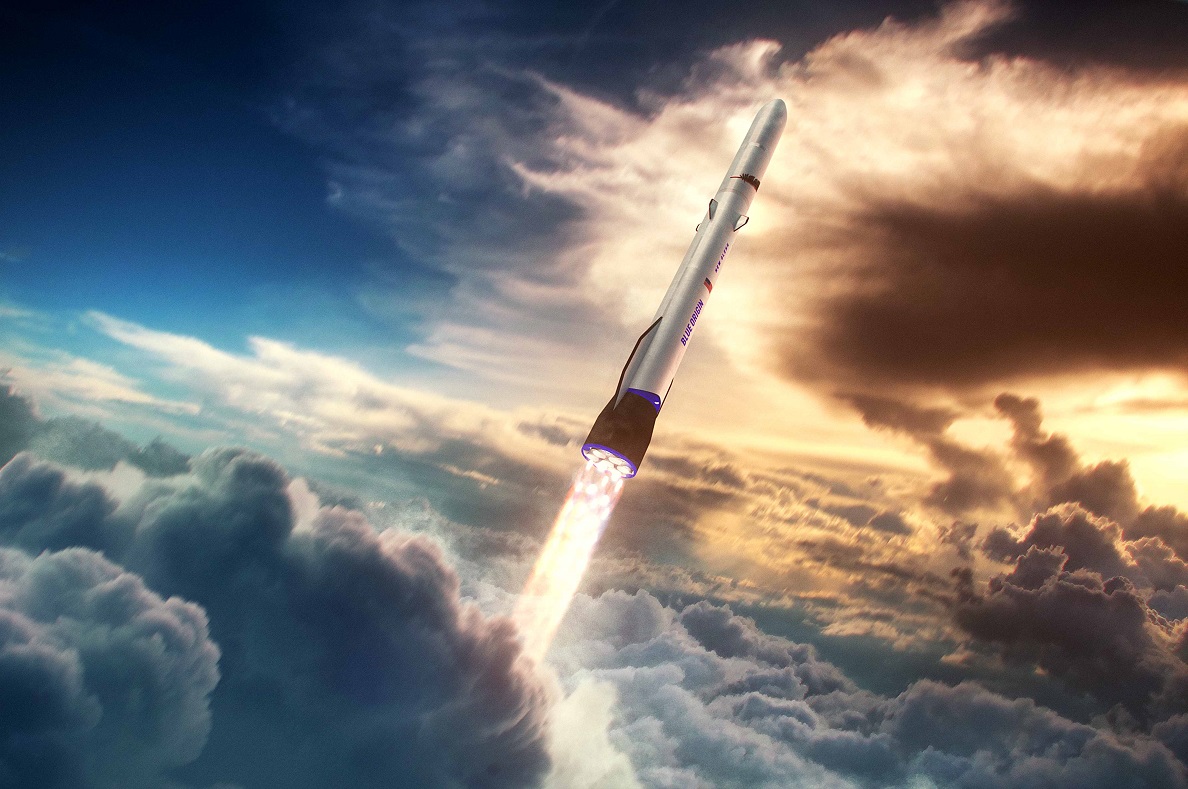
Blue Origin, the rocket company owned by Amazon founder Jeff Bezos, has won a Mars exploration contract from NASA for its New Glenn orbital launch vehicle.
The contract is part of the US space organisation's EscaPADE mission (escape and plasma acceleration and dynamics explorers) to study the immediate region around Earth’s nearest planetary neighbour.
Originally planned for 2022, a new launch is targeted for late 2024, NASA said, then take another 11 months once the spacecraft leave Earth's orbit and arrive at the red planet.
New Glenn is a single-configuration heavy-lift rocket, designed to be capable of carrying people and payloads of up to 45 tonnes to Earth orbit and beyond, with a reusable first stage (built to last 25 missions).
A twin-spacecraft mission, EscaPADE will study solar wind energy transfer through what scientists say is Mars’ unique hybrid magnetosphere in order to gain a better understanding of space weather.
Blue Origin was one of 13 companies that won tenders to provide services under a five-year launch services framework contract with NASA in January last year - a fixed-price indefinite-delivery/indefinite-quantity contracts have a maximum total value of US$300mln across all contracts.
“EscaPADE follows a long tradition of NASA Mars science and exploration missions, and we’re thrilled NASA’s Launch Services Program has selected New Glenn to launch the instruments that will study Mars’ magnetosphere,” said Jarrett Jones, senior vice president for New Glenn at Blue Origin, in a statement.
It is some positive news for Blue Origin after one of its rockets failed shortly after lift-off in an uncrewed mission in September, leading to an cargo capsule aborting to safety before crashing into the Texas desert.
Last August, the company completed its sixth crewed spaceflight and 22nd successful mission into space, via its New Shepard 100% reusable, fully autonomous rocket.
New Glenn versus Starship
The NASA contract came just ahead a big day for rocket rival SpaceX, which successfully conducted a key test of its massive new, 39-engine Starship rocket system, which owner Elon Musk hopes will revolutionise space travel and potentially enable interplanetary travel.
At 98 metres tall and 7m wide New Glenn is smaller than the 120m-by-9m Starship (well actually the top bit is 50m high with the bottom 70m being the Super Heavy cargo rocket).
New Glenn's with its 45 tonnes capacity to low-Earth orbit (or 13 tonnes to geosynchronous transfer orbit) paling in comparison with the 150 tonnes that SpaceX has boasted it will be capable to LEO, GTO and the moon.
Both will offer many times the payload volume of any existing launch vehicle, while on reusability SpaceX rocket is designed for both stages to be reusable, while only New Glenn's lower stage will return to Earth.
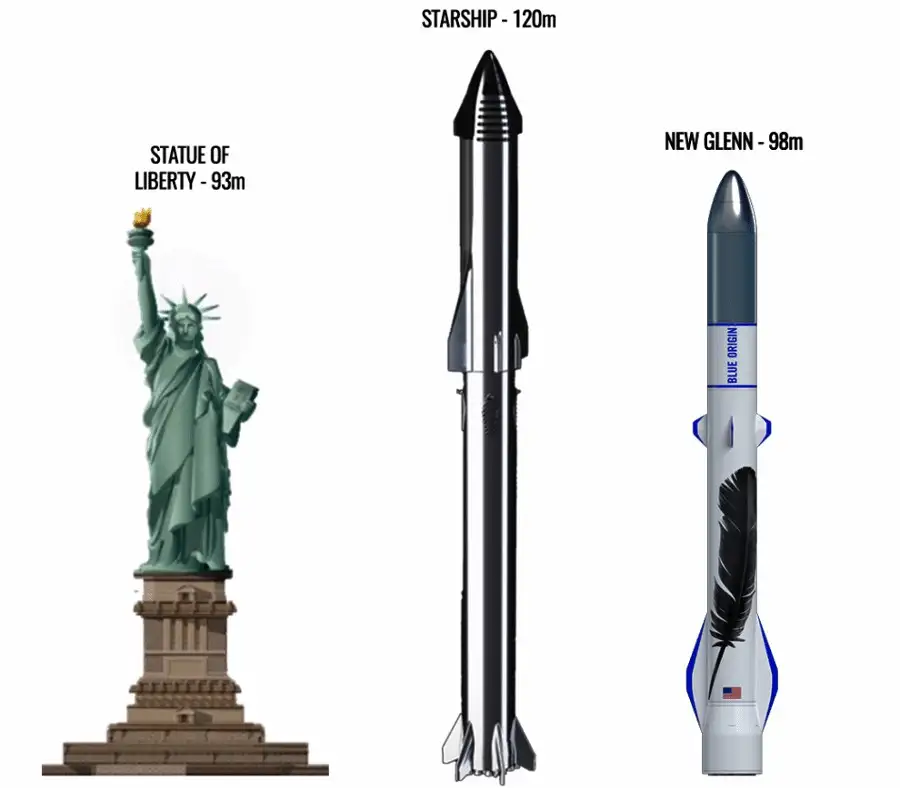
Image from OrbitalToday
They are not alone in the new class of heavy-lift rockets, with United Launch Alliance - a longtime NASA contractor and joint venture between Lockheed Martin and Boeing - hoping to launch 62m tall Vulcan Centaur, replacing existing Atlas V and Delta IV Heavy rockets.
The first Vulcan Centaur test flight is this year with three orbital missions: carrying two demonstration satellites to low-Earth orbit, placing a lunar lander in an elliptical orbit, and delivering another payload to a trajectory that will take it beyond the Earth-moon system.
Europe's contender is Arianespace, which is introducing a similarly sized new rocket to the Vulcan, the Ariane 6, which replaces its older sister with a lower-cost offering.